
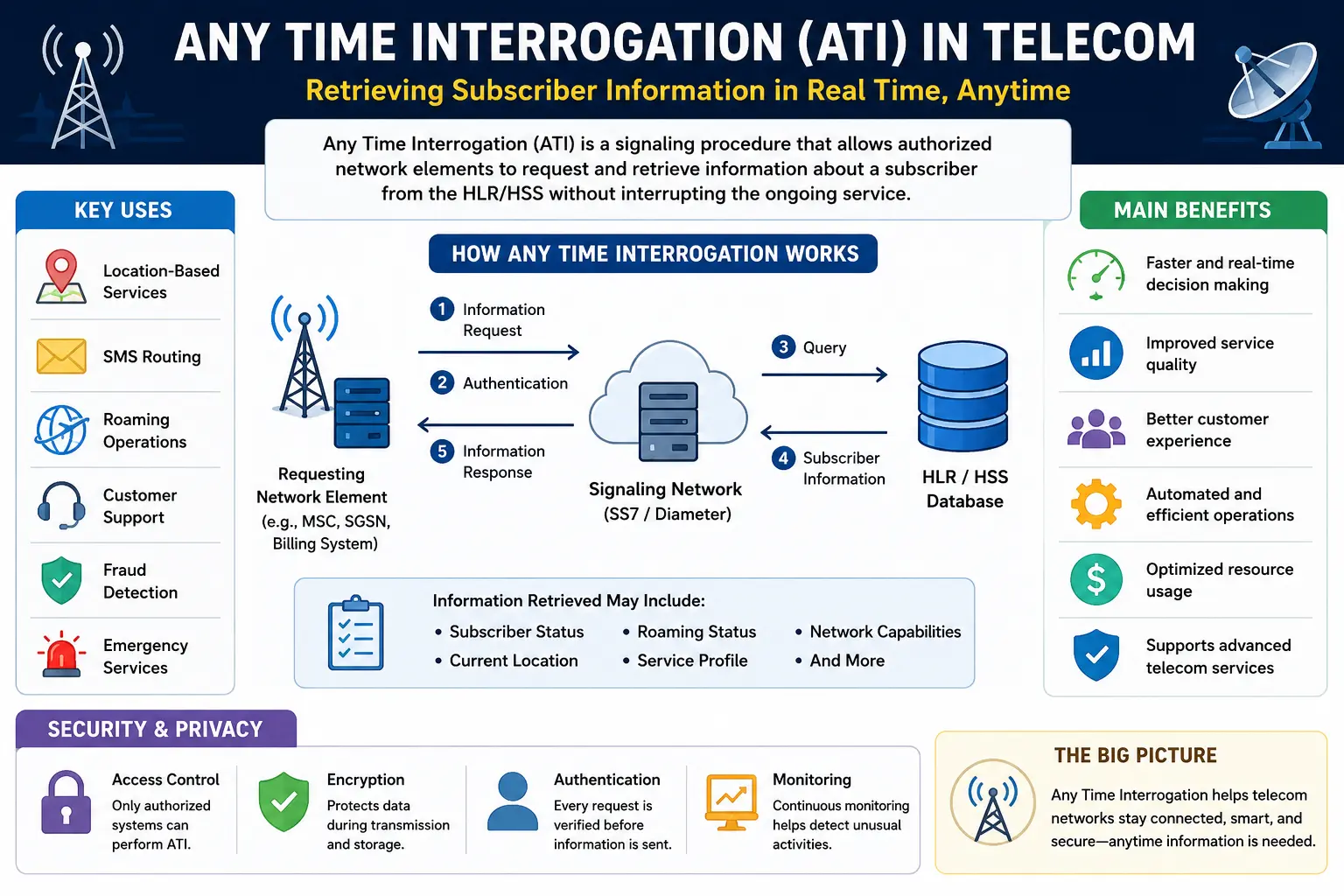
Mobile communication depends on hundreds of background processes that users never notice. One of the most important is any time interrogation, a telecom feature that allows authorized network systems to retrieve subscriber information without interrupting an active service. It helps operators verify user status, support location-based services, improve network management, and deliver a better customer experience.
Although the name sounds technical, the concept is straightforward. Modern mobile networks constantly exchange information between different systems to keep calls connected, messages delivered, and data services running smoothly. Any Time Interrogation (ATI) is one of the signaling procedures that makes this possible.
This guide explains how ATI works, why telecom companies rely on it, where it is used, its advantages, limitations, and what the future holds for this important technology.
What Is Any Time Interrogation?
Any time interrogation is a signaling procedure used in GSM, UMTS, and LTE networks to retrieve information about a mobile subscriber from the Home Location Register (HLR) or Home Subscriber Server (HSS).
Instead of waiting for a subscriber to perform an action, the network can request information whenever it is needed. This information may include:
- Subscriber availability
- Current serving network
- Roaming status
- Location information
- Service permissions
- Network capabilities
The process happens behind the scenes and usually takes only a few milliseconds.
Why Telecom Networks Need ATI
Modern mobile operators manage millions of subscribers simultaneously. Every second, customers make calls, send messages, browse the internet, and switch between cellular towers.
Without an efficient way to retrieve subscriber information, many telecom services would become slow or unreliable.
ATI allows operators to:
- Verify subscriber status instantly
- Route calls correctly
- Deliver SMS messages efficiently
- Support emergency services
- Improve billing accuracy
- Detect network problems
- Enable location-based applications
Instead of searching manually through multiple databases, the network retrieves the required information automatically.
How Any Time Interrogation Works
Although telecom infrastructure is highly complex, the ATI process follows a simple workflow.
Step 1: Information Request
A trusted network element requests subscriber information.
This request might come from:
- Billing systems
- Customer service platforms
- Mobile switching centers
- Service management systems
- Fraud detection systems
Step 2: Authentication
Before providing information, the network verifies that the requesting system has permission.
Security checks ensure unauthorized systems cannot retrieve subscriber details.
Step 3: Database Lookup
The request reaches subscriber databases such as:
- Home Location Register (HLR)
- Home Subscriber Server (HSS)
These databases store subscriber profiles and current network information.
Step 4: Response Generation
The requested information is collected and prepared.
Examples include:
- Current mobile status
- Serving network
- Roaming information
- Subscriber profile
- Service restrictions
Step 5: Information Delivery
The information is securely returned to the requesting system.
The entire process usually happens almost instantly.
Main Components Involved
Several telecom systems work together during ATI.
| Component | Purpose |
|---|---|
| HLR | Stores subscriber information |
| HSS | Subscriber database in LTE/5G |
| MSC | Manages voice calls |
| SGSN | Supports packet data services |
| Signaling Network | Transfers requests securely |
| Authentication System | Verifies request permissions |
Each component plays a different role but together they maintain seamless communication.
Common Uses of ATI
ATI supports many telecom operations that customers depend on every day.
Location-Based Services
Navigation apps, emergency services, and delivery platforms often rely on subscriber location.
ATI helps determine which network area currently serves the user.
SMS Routing
Before delivering a text message, the network must determine where the subscriber is currently registered.
ATI helps locate the correct destination.
Roaming Services
When subscribers travel internationally, operators need updated information.
ATI allows networks to verify:
- Current country
- Partner operator
- Service availability
- Roaming permissions
Customer Support
When a customer contacts technical support, representatives often need to verify network status.
ATI provides real-time subscriber information that helps identify problems more quickly.
Fraud Prevention
Telecom operators constantly monitor unusual activity.
ATI supports fraud detection by verifying subscriber status before certain transactions occur.
Emergency Communications
Emergency responders may require location information to provide faster assistance.
Network interrogation procedures can support emergency service operations where legally permitted.
Advantages of Any Time Interrogation
ATI offers numerous benefits for both operators and subscribers.
Faster Network Decisions
Real-time subscriber information allows operators to react immediately to changing conditions.
Better Service Quality
Accurate subscriber information reduces connection errors and improves communication reliability.
Improved Customer Experience
Customers enjoy:
- Faster call routing
- Reliable messaging
- Better roaming
- Improved network stability
Lower Manual Work
Many processes become fully automated.
Instead of manually checking subscriber information, systems retrieve it automatically.
Better Resource Management
Operators can optimize network resources more efficiently by understanding subscriber activity.
Supports Advanced Telecom Services
ATI enables many services including:
- Smart routing
- Real-time billing
- Network optimization
- Subscriber analytics
- Service activation
Technologies Behind ATI
Several telecom technologies support Any Time Interrogation.
SS7
Signaling System No. 7 remains one of the most important telecom signaling protocols.
It enables communication between network components.
Diameter
Diameter is commonly used in LTE networks.
It provides secure authentication and subscriber management.
SIGTRAN
SIGTRAN transports traditional signaling messages over IP networks.
It improves flexibility and scalability.
HLR and HSS Databases
These databases remain central to subscriber management.
They store:
- Phone numbers
- Authentication data
- Service subscriptions
- Roaming status
- Network profiles
Security Considerations
Because ATI retrieves subscriber information, security is extremely important.
Telecom operators implement several protective measures.
Access Control
Only authorized network systems can perform ATI requests.
Encryption
Modern telecom networks encrypt signaling traffic to reduce interception risks.
Authentication
Every request is verified before subscriber information is released.
Monitoring
Operators continuously monitor unusual signaling activity.
Suspicious requests may trigger security alerts.
Compliance
Telecom providers must comply with privacy regulations governing subscriber information.
Sensitive data cannot be shared without proper authorization.
Challenges of ATI
Although ATI is valuable, operators face several challenges.
Increasing Network Complexity
Modern networks include:
- 4G
- 5G
- Cloud infrastructure
- Virtualized services
Managing signaling across these environments requires careful planning.
Security Threats
Cybercriminals continue targeting telecom signaling systems.
Operators must regularly update security measures.
Large Subscriber Volumes
Major operators manage millions of users simultaneously.
Infrastructure must scale without affecting performance.
Integration Issues
Older telecom equipment sometimes struggles to integrate with newer technologies.
Successful modernization often requires phased upgrades.
FAQs
1. What is Any Time Interrogation in telecom?
Any Time Interrogation (ATI) is a signaling procedure used in mobile networks to retrieve real-time information about a subscriber without interrupting their service. It helps telecom operators access details such as subscriber status, location, and roaming information to support various network operations.
2. Why is Any Time Interrogation important?
ATI is important because it enables telecom operators to manage their networks efficiently. It supports accurate call routing, SMS delivery, location-based services, fraud detection, and customer support while ensuring subscribers receive reliable and uninterrupted mobile services.
3. Is Any Time Interrogation secure?
Yes, ATI is secure when implemented correctly. Mobile operators use authentication, encryption, access controls, and continuous monitoring to protect subscriber information. Only authorized systems can perform ATI requests, helping maintain user privacy and network security.
4. Which mobile networks use Any Time Interrogation?
ATI is commonly used in GSM, UMTS, LTE, and many modern telecom environments. It works alongside network components such as the Home Location Register (HLR) and Home Subscriber Server (HSS) to retrieve subscriber information whenever required.
5. Can Any Time Interrogation track a user’s exact location?
ATI can provide network-related location information for authorized telecom services, but it is not designed for public tracking. Access is restricted to approved network systems and must comply with local laws, privacy regulations, and operator security policies.
Conclusion
Any Time Interrogation plays a vital role in modern telecommunications by allowing operators to retrieve subscriber information quickly and securely without disrupting ongoing services. From improving call routing and roaming support to enhancing customer service and network management, ATI helps maintain reliable mobile communication. As telecom networks continue to evolve with 5G and future technologies, this signaling procedure will remain an essential component for delivering efficient, secure, and high-quality mobile services.