
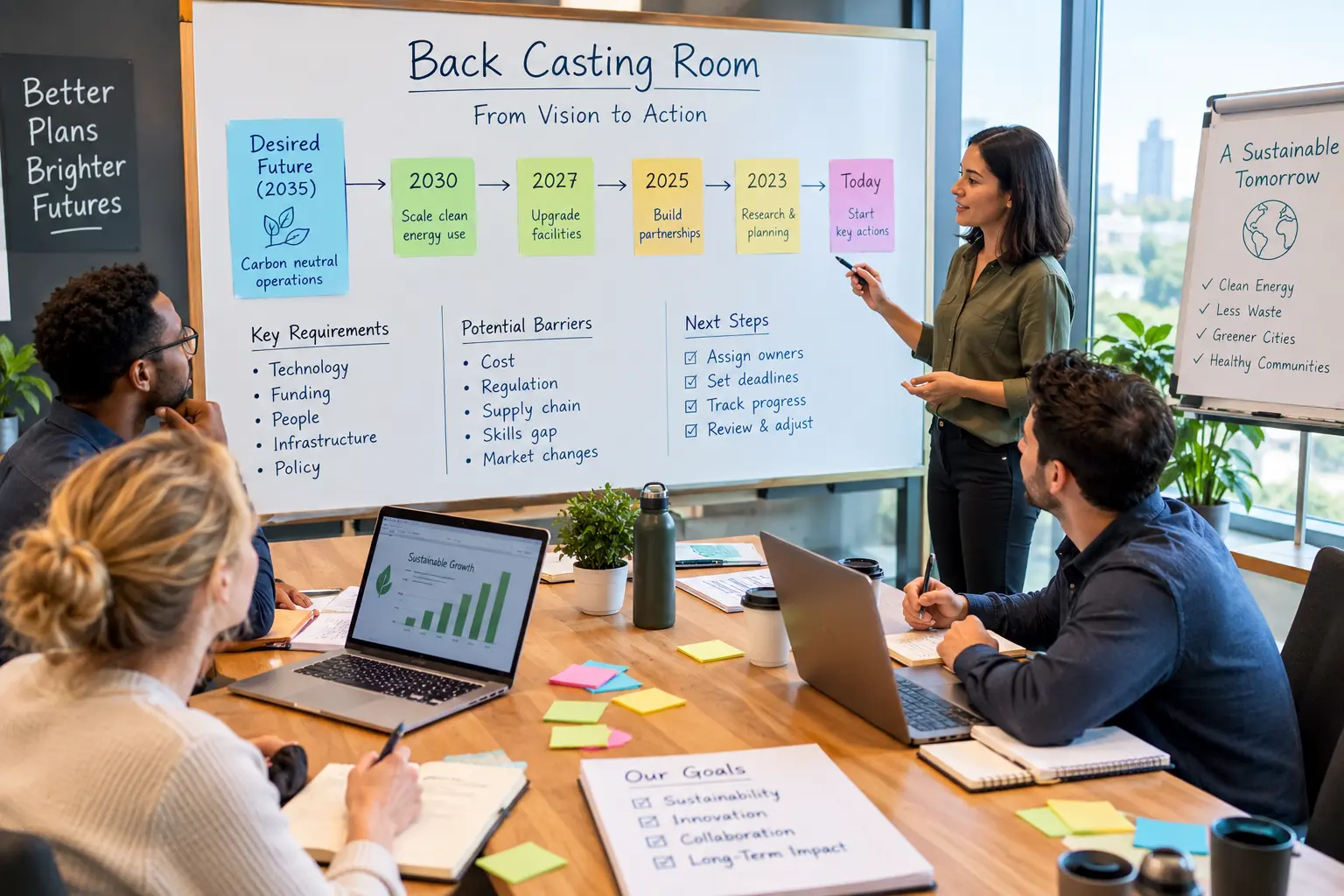
Planning for the future can be difficult when current conditions keep changing. A back casting room offers a structured environment where people can imagine a specific future outcome and then work backward to determine what needs to happen to make that outcome possible. Rather than simply extending today’s trends, this approach encourages teams to question assumptions, explore alternatives, and identify practical actions that connect the present with a desired future.
The concept is useful for organizations dealing with long-term challenges, including sustainability, business transformation, technology adoption, urban planning, education, and organizational development. It combines creative thinking with structured planning so that a distant goal becomes easier to translate into realistic milestones.
What Is Backcasting?
Backcasting is a planning technique that begins with a clearly defined future and moves backward toward the present. The central question is not simply, “What is likely to happen?” Instead, the team asks, “What future do we want, and what would need to happen for us to reach it?”
This distinction separates backcasting from conventional forecasting.
Forecasting generally starts with information about the present. A business might examine sales, customer behavior, economic conditions, or industry trends and then estimate what those patterns could look like several years from now.
Backcasting takes the opposite direction:
- Define a desirable future.
- Describe what that future looks like in practical terms.
- Identify the conditions required to reach it.
- Work backward through major milestones.
- Determine what must happen now.
- Convert those requirements into actions, responsibilities, and timelines.
For example, a company might establish a goal of becoming largely dependent on renewable energy by 2040. Instead of predicting how energy use will naturally develop, the team begins with the 2040 objective and works backward. It might identify infrastructure requirements, supplier changes, investment decisions, employee training, technology upgrades, and interim targets.
The value lies in making a distant ambition actionable.
Why Backcasting Differs From Forecasting
Both approaches can support strategic decisions, but they answer different questions.
| Backcasting | Forecasting |
|---|---|
| Starts with a desired future | Starts with current conditions |
| Works backward toward the present | Projects current patterns forward |
| Focuses on what needs to change | Focuses on what may happen |
| Useful for transformational goals | Useful for estimating likely outcomes |
| Challenges existing assumptions | Often relies on existing trends |
| Encourages alternative pathways | Often emphasizes continuity |
Neither method has to replace the other. A planning team can use forecasts to understand market conditions while using backcasting to determine the changes required to achieve an ambitious objective.
This combination can be especially useful when a desired outcome requires significant changes rather than gradual improvement.
Inside a Back Casting Room
A physical back casting room does not need to follow one fixed design. Its purpose is to support the planning process rather than simply provide a meeting space.
The environment should make it easy for participants to see information, move ideas around, record decisions, and compare different pathways.
Useful elements can include:
Large visual surfaces
Whiteboards, writable walls, sticky notes, planning boards, or large displays allow participants to map relationships between goals, milestones, and actions.
Shared digital workspace
Teams working across different locations can use collaborative planning software, digital whiteboards, shared documents, and project management platforms.
Timeline displays
A visible timeline can show the desired endpoint and intermediate milestones. Participants can then identify what must be achieved at each stage.
Flexible seating
Traditional conference-room arrangements can make workshops feel rigid. Movable chairs and tables allow the room to change according to the activity.
Research materials
Relevant market reports, customer information, regulations, technical documents, historical data, and environmental information can help participants challenge assumptions.
The room itself is less important than the quality of the thinking that takes place inside it. A simple space can work effectively when the process is well designed.
How a Back Casting Workshop Works
A successful session usually follows a sequence rather than becoming an open-ended brainstorming meeting.
1. Establish the future scenario
The first step is to describe the desired future in enough detail that everyone understands what success means.
Instead of saying, “We want to be more sustainable,” a team might define a future where its operations produce substantially less waste, use cleaner energy, and meet clearly established environmental targets.
A measurable future creates something concrete to work toward.
2. Identify the conditions for success
Participants then ask what would have to be true for that future to exist.
These conditions might involve:
- Technology
- Funding
- Skills
- Infrastructure
- Regulations
- Customer behavior
- Supply chains
- Leadership
- Partnerships
- Internal processes
This stage helps expose requirements that might otherwise remain hidden.
3. Work backward through milestones
Once the necessary conditions are known, the team moves backward.
For example:
2040: Desired future achieved
2035: Major systems fully operational
2030: Infrastructure and partnerships established
2028: Pilot programs completed
2027: Investment and implementation plan approved
2026: Research, targets, and responsibilities defined
The exact dates will vary, but the principle remains the same: each milestone should create conditions needed for the next stage.
4. Identify barriers
Teams should examine what could prevent progress.
A useful workshop does not assume that everything will go according to plan. Participants can consider financial limitations, regulatory changes, technology failures, staffing shortages, market shifts, or resistance to organizational change.
5. Translate milestones into present actions
The final stage brings the discussion back to today.
A long-term goal becomes useful only when people know what they should do next. Each action should ideally have an owner, deadline, required resources, and a way to measure progress.
Where Backcasting Can Be Used
The method can be adapted to many situations because it is not tied to a particular industry.
Sustainability and environmental planning
Long-term environmental objectives often require changes across several systems at once. Organizations may use backcasting to determine how energy consumption, transportation, manufacturing, waste management, or resource use needs to change.
For example, a company targeting substantial emissions reductions could begin with its future environmental objective and work backward to determine which facilities, suppliers, technologies, and operational practices need to change.
Business transformation
Companies sometimes know what they want their organization to look like several years from now but struggle to determine how to get there.
Backcasting can break that vision into manageable stages involving products, employees, technology, customers, revenue models, and internal operations.
Urban and regional planning
Cities face long planning horizons involving housing, transportation, infrastructure, public services, energy, and population growth.
Instead of only estimating future demand, planners can define a preferred future urban environment and identify policies and investments needed to move toward it.
Technology strategy
Emerging technologies can create uncertainty because today’s systems may not resemble future operating environments.
A company could define a future technology architecture and work backward to determine which systems should be upgraded, replaced, integrated, or retired.
Education and institutional planning
Schools and universities can also use future-oriented planning. A desired future might involve improved digital learning, new academic programs, better student services, or expanded research capabilities.
The backcasting process can then identify staffing, infrastructure, funding, training, and policy changes required along the way.
Advantages of Using a Back Casting Room
The approach offers several practical benefits when the planning process is properly managed.
It makes long-term goals more concrete
A goal that sits 10 or 20 years away can feel abstract. Working backward creates intermediate checkpoints that make progress easier to understand.
It encourages unconventional thinking
Starting from a desired outcome can free participants from assumptions about what is possible under current conditions. This does not mean ignoring reality. It means considering what changes might be required instead of automatically accepting today’s limitations.
It improves strategic alignment
Different departments may have different priorities. A shared future scenario gives them a common reference point.
Marketing, finance, operations, technology, and human resources can then consider how their individual decisions contribute to the same long-term direction.
It reveals dependencies
A major goal may depend on several smaller changes happening in the correct sequence.
For instance, adopting a new technology may require employee training before deployment, infrastructure improvements before training, and investment approval before infrastructure work begins.
Mapping these relationships can reveal dependencies that ordinary planning may overlook.
It supports better conversations
A structured workshop can bring together people with different expertise. Engineers may identify technical constraints, financial teams may identify investment requirements, and operational staff may point out practical difficulties.
The result can be more comprehensive than planning conducted by one department alone.
Common Problems and How to Avoid Them
Backcasting is useful, but it is not automatically effective. Poorly designed sessions can produce attractive visions without a credible path toward them.
The future is too vague
“Become a leading company” is not specific enough.
A stronger future scenario explains what success actually looks like. It may include measurable operational, financial, environmental, customer, or organizational outcomes.
Participants ignore present constraints
Future-focused thinking should not become detached from reality.
After developing an ambitious scenario, teams should test it against budgets, technical capabilities, regulations, available skills, and other practical limitations.
Too many people dominate the discussion
A workshop can become ineffective when a small number of participants control every decision.
A facilitator can use structured exercises, individual idea generation, timed discussions, and voting or prioritization methods to give different perspectives space.
The plan stops at the vision
A beautiful future scenario has limited value without an implementation path.
Every major milestone should eventually connect to specific actions. If no one knows who is responsible for the next step, the workshop has not fully achieved its purpose.
Assumptions are treated as facts
Participants may make predictions about future technology, customer behavior, regulation, or economics. These should be identified as assumptions and reviewed periodically.
A good plan can change when new evidence appears.
How to Make Sessions More Productive
A well-prepared back casting room can help participants move from broad ideas to practical decisions.
Before the session, organizers should define the planning question, collect relevant evidence, invite people with different areas of expertise, and establish the desired output.
During the workshop, several practices can improve results:
- Separate the desired future from the pathway used to reach it.
- Record assumptions separately from confirmed facts.
- Use specific milestones rather than vague intentions.
- Challenge participants to identify alternative pathways.
- Assign responsibility for major actions.
- Document disagreements instead of hiding them.
- Leave time to discuss barriers.
- Review the plan periodically after the workshop.
Facilitation is particularly important. The facilitator should keep discussions focused without deciding the outcome for the group.
A Simple Example
Imagine a regional food company wants to build a supply chain that is significantly more resilient by 2035.
The team begins by describing the 2035 situation. It wants multiple reliable suppliers, stronger local sourcing, improved inventory visibility, efficient logistics, and contingency plans for major disruptions.
Working backward could produce a pathway such as:
2035: Resilient supply network operating across several markets.
2032: Alternative suppliers and logistics partnerships established.
2029: Supplier diversification and digital monitoring systems fully implemented.
2027: Pilot programs tested across selected product categories.
2026: Supply-chain vulnerabilities mapped and investment priorities approved.
This exercise does not predict exactly what will happen. Instead, it creates a pathway toward a selected future while making room for adjustment as circumstances change.
That distinction is one of the most useful features of backcasting.
Tools That Can Support the Process
Technology can make planning sessions easier, especially when teams work across locations.
Useful tools include:
- Digital whiteboards for mapping ideas
- Spreadsheet models for timelines and resource estimates
- Project management systems for assigning actions
- Presentation software for future scenarios
- Survey tools for collecting stakeholder input
- Data dashboards for monitoring progress
- Video conferencing platforms for remote workshops
However, technology should support the thinking rather than dominate it. A complicated software setup can create unnecessary friction.
For smaller teams, sticky notes, paper timelines, markers, and a large wall may be enough.
Measuring Progress After the Workshop
A strategic workshop should not be treated as a one-time event.
Once the pathway has been created, organizations can establish key performance indicators for major milestones. These might measure investment, implementation, operational performance, customer adoption, environmental impact, employee capabilities, or other relevant outcomes.
Regular reviews can answer three questions:
- What has been completed?
- What has changed since the original plan?
- Does the pathway still lead toward the desired future?
The third question matters because long-term planning operates under uncertainty. New technologies, regulations, economic conditions, or customer preferences can change the environment.
A strong plan should therefore be adaptable rather than permanently fixed.
Frequently Asked Questions
What is the main purpose of a back casting room?
The main purpose is to provide a structured environment for future-focused planning. Participants define a desirable future, identify the conditions needed to achieve it, and work backward to determine milestones and present-day actions. The space can be physical or virtual, provided it supports collaboration, visualization, discussion, and documentation.
Is backcasting the same as strategic planning?
Not exactly. Backcasting is a specific method that can be incorporated into strategic planning. Traditional strategy processes may analyze current performance, competitors, resources, and market conditions before developing objectives. Backcasting begins with a desired future and works backward to identify the pathway required to reach it.
Who should participate in a backcasting workshop?
Participants should represent the areas that can influence or be affected by the future objective. Depending on the project, this might include executives, technical specialists, finance professionals, operations staff, researchers, customers, community representatives, or external experts. A diverse group can reveal dependencies and practical issues that one department may overlook.
Can a small business use backcasting?
Yes. A small business does not need a dedicated facility or expensive software. A team can use a whiteboard or digital workspace to describe its desired future, identify major milestones, and determine immediate priorities. The method can be scaled to fit the organization’s resources, planning horizon, and complexity.
How far into the future should a backcasting plan look?
There is no universal timeframe. The horizon should match the type of goal being considered. A technology project might require several years, while infrastructure, environmental, or urban-development initiatives may require decades. The future date should be far enough away to encourage meaningful change but specific enough to support measurable milestones.
What is the biggest mistake in backcasting?
One common mistake is creating an attractive future vision without developing a realistic pathway to reach it. Another is failing to revisit assumptions as circumstances change. Effective backcasting connects the desired outcome to measurable milestones, responsible people, resources, and regular reviews.
Does backcasting guarantee that the desired future will happen?
No. Backcasting is a planning method rather than a prediction or guarantee. External events can change the conditions surrounding a plan. Its value comes from helping people identify possible pathways, dependencies, barriers, and actions while leaving room to revise those pathways when new information becomes available.
Final Thoughts
Long-term planning becomes more practical when teams stop treating the future as something that can only be predicted. By defining a clear destination and then tracing the necessary steps back toward the present, organizations can examine what needs to change, which milestones matter, and where current decisions fit into a larger objective.
A back casting room can support this process by giving people the space, tools, and structure needed to think beyond immediate priorities. The most effective approach combines ambitious thinking with evidence, realistic constraints, measurable milestones, and regular review. When those elements work together, a distant vision can become a practical pathway for action.