
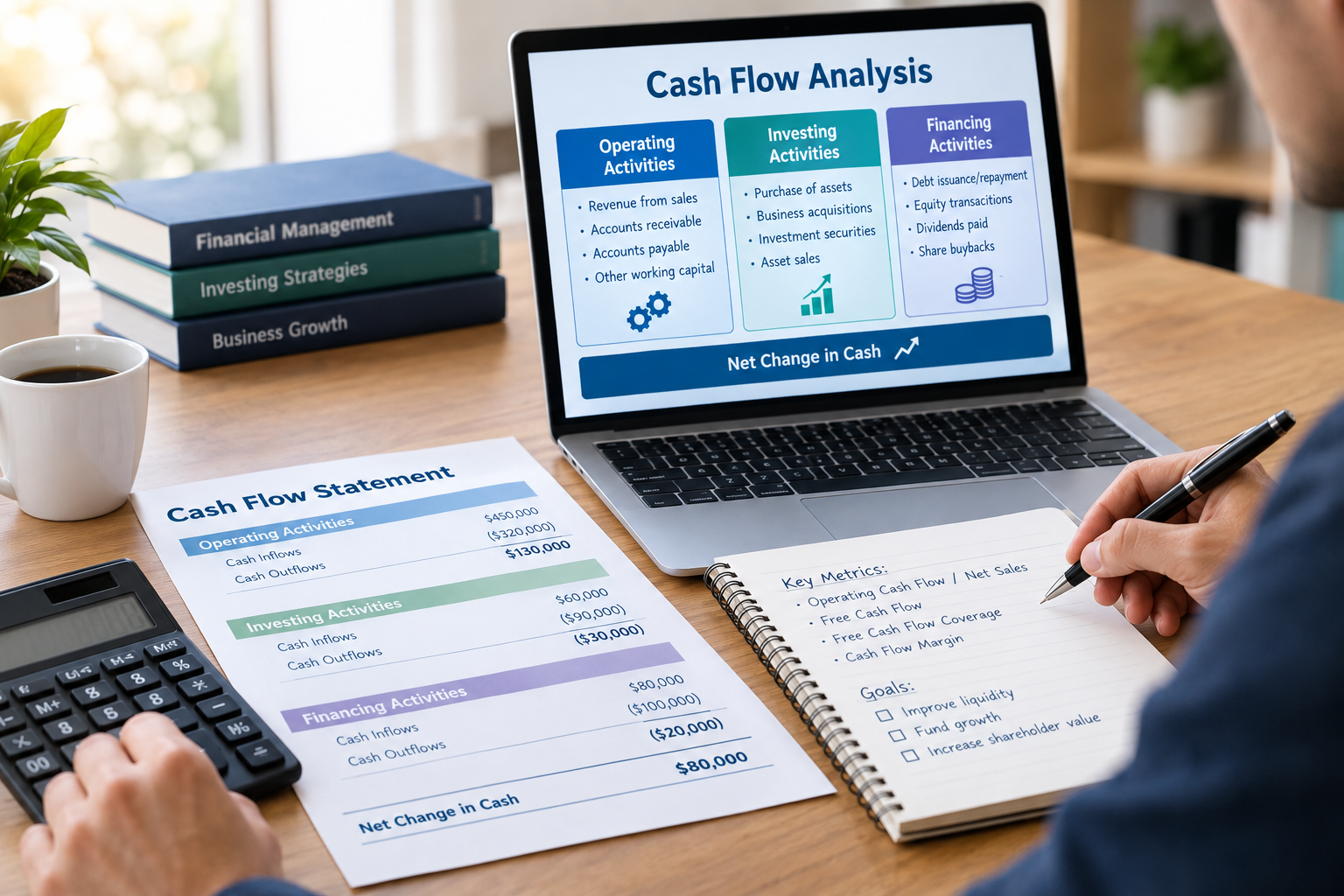
Cash flow analysis helps a business understand a simple but critical question: Is enough actual cash coming in to cover what the company needs to pay? A business can report strong sales and even show a profit while still struggling to pay suppliers, employees or lenders. Looking at cash movement gives owners, managers and investors another way to judge financial strength.
The process involves examining cash received and cash spent during a specific period. It also helps explain why the cash balance changed and whether that change came from normal business activity, investments or financing. Once these movements are understood, financial decisions become easier to make.
Why Cash Position Matters More Than a Profit Figure Alone
Profit and cash are connected but they are not the same thing.
A company may make a sale today and allow the customer 60 days to pay. The revenue may already appear in the accounts but the business cannot use that money until it actually arrives. Meanwhile, wages, rent and suppliers may need to be paid immediately.
This timing difference can create serious pressure.
A healthy business therefore needs to watch several things at once:
- Revenue growth
- Net income
- Accounts receivable
- Accounts payable
- Inventory levels
- Operating expenses
- Debt payments
- Capital spending
- Available cash reserves
A company with modest profits but dependable collections may be financially stronger than a rapidly growing company whose customers take months to pay.
That is why cash management is particularly important for small businesses and companies experiencing rapid growth. Higher sales often require more inventory, additional employees and larger operating expenses before the related customer payments arrive.
The Three Sources of Cash Movement
A cash flow statement organizes transactions into three broad categories. Understanding these categories makes the statement much easier to read.
| Category | What it shows | Common examples |
|---|---|---|
| Operating activities | Cash connected with normal business operations | Customer receipts, supplier payments, wages, taxes |
| Investing activities | Cash used for or received from long-term investments | Equipment purchases, property sales, acquisitions |
| Financing activities | Cash involving lenders and owners | Loans, share issues, repayments, dividends |
The categories answer different questions.
Operating cash flow: Is the core business generating cash?
Investing cash flow: Where is the company putting money into long-term assets or investments?
Financing cash flow: Is the company raising money from lenders or owners or returning money to them?
Looking at all three together gives a much clearer picture than examining the ending bank balance alone.
How to Read a Cash Flow Statement
A useful way to approach a cash flow statement is to work from the top-level categories toward the reasons behind each movement.
1. Start with operating activities
Operating activities are usually the first place to look because they show whether the company’s primary business model produces cash.
A positive operating figure can indicate that customers are generating enough cash to support everyday operations. A negative figure deserves further investigation.
For example, suppose a retailer reports rising revenue but operating cash falls sharply. That could happen because the company purchased large amounts of inventory or customers have not paid their invoices.
The number itself is only the starting point. The underlying cause matters more.
2. Examine investing activity
Investment cash flow often looks negative when a company is purchasing equipment, buildings, technology or other long-term assets.
That is not automatically a warning sign.
A manufacturer spending $2 million on a new production line may report substantial investing outflows while making a sensible long-term decision. The new equipment could increase production capacity and eventually generate additional cash.
On the other hand, a company that consistently reports positive investing cash flow because it is selling important assets may deserve closer attention.
3. Review financing activity
Financing activities reveal how the business obtains capital and how it returns capital to lenders or shareholders.
Common financing movements include:
- New borrowing
- Repayment of loans
- Issuing shares
- Repurchasing shares
- Dividend payments
- Other transactions involving owners or creditors
A company can have positive total cash flow because it borrowed heavily. That does not necessarily mean its operations are strong.
This is why investors should avoid judging financial health from the final cash number alone.
A Simple Way to Perform Cash Flow Analysis
A practical Cash Flow Analysis does not require dozens of complicated formulas. Start with the cash flow statement and then investigate the major movements.
Step 1: Identify the opening and closing cash balances
Compare the amount of cash at the beginning of the reporting period with the amount at the end.
The difference shows whether cash increased or decreased overall.
Step 2: Separate operating, investing and financing movements
Look at each section individually rather than immediately focusing on the total.
Ask:
- Did normal operations produce cash?
- Was cash spent on expansion?
- Did borrowing increase?
- Were loans repaid?
- Were dividends distributed?
- Were assets sold to raise cash?
Step 3: Look for unusual changes
Large movements deserve an explanation.
For example, an unexpected increase in accounts receivable could mean sales are growing faster than collections. A major increase in inventory could suggest preparation for higher demand or slower product turnover.
Step 4: Compare several periods
One month or one quarter can be misleading.
Reviewing several periods helps reveal whether cash generation is improving, deteriorating or moving in cycles.
Step 5: Compare the business with its industry
A cash profile that looks unusual in one industry may be completely normal in another. Retailers, manufacturers, software companies and construction businesses can have very different working-capital requirements.
Historical performance and industry peers provide useful context.
Operating Cash Flow and Revenue: An Important Relationship
Revenue growth looks attractive, but investors should also ask whether that growth is producing actual cash.
One useful measure is the operating cash flow margin:
Operating Cash Flow Margin = Operating Cash Flow ÷ Revenue × 100
Suppose a company produces $500,000 in operating cash from $2.5 million of revenue.
Its operating cash flow margin would be:
$500,000 ÷ $2,500,000 × 100 = 20%
This means the company generated 20 cents of operating cash for every dollar of revenue during the period.
There is no universal margin that makes a business healthy. Industry economics, business maturity and accounting practices all matter. The more useful approach is to compare the company’s current margin with its own historical results and relevant competitors.
A falling margin while revenue continues to rise may deserve investigation.
Free Cash Flow Shows What Remains After Investment
Operating cash flow tells you how much cash the core business generated. Free cash flow goes one step further by considering spending on capital assets.
A commonly used formula is:
Free Cash Flow = Operating Cash Flow − Capital Expenditures
For example:
- Operating cash flow: $800,000
- Capital expenditures: $250,000
- Free cash flow: $550,000
That $550,000 represents cash remaining after the company funded its operating activities and purchased the relevant long-term assets included in the calculation.
A business may use free cash flow to:
- Reduce debt
- Build cash reserves
- Pay dividends
- Repurchase shares
- Fund acquisitions
- Invest in expansion
- Develop new products
Free cash flow is especially useful when examining established businesses because it provides insight into how much internally generated cash remains after necessary investment.
Positive Cash Flow Does Not Always Mean a Healthy Business
A positive cash figure sounds encouraging, but its source matters.
Imagine a company has:
- $100,000 negative operating cash flow
- $300,000 positive investing cash flow
- $200,000 positive financing cash flow
The company may finish the period with more cash than it started with. Yet its core operations are not generating cash.
The positive investing figure might have come from selling equipment. The financing figure could have resulted from taking on new debt.
That situation is very different from a company whose operations consistently produce cash without depending heavily on asset sales or new borrowing.
The quality of cash generation is therefore just as important as the total amount.
What Negative Cash Flow Can Actually Mean
Negative cash flow should not automatically be treated as evidence of failure.
A young company may spend heavily on:
- Product development
- Hiring
- Marketing
- New facilities
- Technology
- Inventory
- Market expansion
These investments can create negative cash flow today while supporting future growth.
The key questions are:
- Why is cash declining?
- How long can the company sustain the decline?
- Does management have adequate funding?
- Are investments producing measurable results?
- Is operating cash moving toward improvement?
A temporary decline caused by strategic investment is very different from persistent losses caused by an unsustainable business model.
Working Capital Can Explain Major Cash Changes
Working capital is one of the most useful areas to examine when trying to understand why cash differs from reported profit.
Three items deserve particular attention.
Accounts receivable
When accounts receivable rise, customers owe the business more money. Revenue may have been recognized but cash has not necessarily been collected.
Rapidly increasing receivables can therefore put pressure on liquidity.
Inventory
A business that purchases inventory spends cash before those goods are sold.
Large inventory increases can reduce available cash. Sometimes this reflects planned growth. At other times, it may indicate weak demand or inefficient inventory management.
Accounts payable
Accounts payable represent amounts owed to suppliers and other vendors.
When a business delays payment within agreed terms, it can temporarily retain cash. However, stretching payments too far can damage supplier relationships or create late fees.
Good working-capital management balances liquidity with healthy business relationships.
Cash Flow Analysis Example
Consider a fictional company called Northstar Tools.
During one quarter, it records:
| Cash movement | Amount |
|---|---|
| Cash generated from operations | $420,000 |
| Equipment purchases | ($180,000) |
| Proceeds from asset sales | $30,000 |
| New loan proceeds | $100,000 |
| Loan repayments | ($70,000) |
| Dividends | ($40,000) |
The company generated $420,000 from its core operations. Its investing activities resulted in a net outflow of $150,000. Financing produced a net inflow of negative $10,000 after considering borrowing, repayments and dividends.
The overall cash movement is therefore:
$420,000 − $150,000 − $10,000 = $260,000 increase in cash
At first glance, that is a strong result. More importantly, most of the increase came from operations rather than borrowing or asset sales.
The equipment purchase also suggests that the company is investing in its productive capacity. The next step would be to examine whether those investments are likely to support future revenue and cash generation.
Common Warning Signs to Watch
Certain patterns deserve additional investigation.
Sales rise while operating cash falls
This can happen when customers take longer to pay or when working-capital requirements increase.
Cash increases mainly because of borrowing
Debt can strengthen liquidity temporarily but creates future repayment obligations.
Free cash flow remains negative for years
For an expanding company this may be intentional. For a mature company it may signal that the business requires unusually heavy investment just to maintain operations.
Receivables grow faster than revenue
This may indicate weaker collection performance or increasingly generous credit terms.
Inventory keeps accumulating
Excess inventory ties up cash and can eventually lead to discounts, write-downs or obsolete products.
Asset sales repeatedly support cash balances
Selling assets can provide immediate liquidity but is difficult to sustain indefinitely if the business continues operating.
Cash Accounting vs. Accrual Accounting
The difference between cash and accrual accounting helps explain why profit and cash can move in different directions.
Under cash accounting, revenue is generally recorded when money is received and expenses are recorded when payments are made.
Under accrual accounting, transactions are generally recognized when revenue is earned or expenses are incurred, regardless of the exact timing of cash settlement.
Consider a company that sells $50,000 worth of products on credit.
Under accrual accounting, the sale may be recognized as revenue even though the customer has not paid yet. The unpaid amount becomes an account receivable.
The income statement can therefore show the sale before the business receives the money.
This distinction is one reason financial analysis works best when the income statement, balance sheet and cash flow statement are considered together.
The Limits of Cash-Based Evaluation
Cash information is valuable but it does not tell the entire story.
A company can have strong cash flow for a short period because of a large loan or an asset sale. Another company can have weak cash flow temporarily because it is funding a major expansion.
Cash flow statements also describe what happened during a particular reporting period. They do not guarantee what will happen next.
For a more complete assessment, examine:
- Income statement
- Balance sheet
- Cash flow statement
- Debt levels
- Profit margins
- Working capital
- Capital expenditure
- Business strategy
- Industry conditions
This broader view reduces the risk of drawing conclusions from one financial metric.
How Businesses Can Improve Their Cash Position
Companies facing cash pressure have several practical options.
Speed up collections
Review customer payment terms and follow up promptly on overdue invoices. Electronic invoicing and automated reminders can shorten collection cycles.
Control inventory
Identify slow-moving products and avoid purchasing more stock than the business can reasonably sell.
Review expenses
Separate essential operating costs from spending that can be delayed, reduced or eliminated.
Negotiate supplier terms
Longer payment terms can improve short-term liquidity when negotiated properly and without harming supplier relationships.
Plan major purchases
Large equipment purchases should be incorporated into a cash forecast rather than handled as unexpected expenses.
Maintain a cash reserve
A reserve can provide protection against seasonal downturns, delayed customer payments and unexpected expenses.
Build a rolling forecast
A weekly or monthly cash forecast can reveal potential shortages before they become emergencies.
Expert Tips for Better Financial Decisions
Good cash management is less about watching one number and more about understanding the story behind the numbers.
Track trends, not isolated results. One unusually strong or weak quarter can distort the picture.
Separate maintenance spending from growth spending. A large capital purchase may reduce current cash while strengthening future earning capacity.
Watch cash conversion. Strong sales are less valuable when customers consistently pay late.
Question the source of positive cash flow. Operating cash generated by customers is generally more meaningful than cash raised through additional debt.
Connect cash with strategy. Financial figures should be interpreted alongside the company’s business plans and industry conditions.
Use realistic forecasts. Cash projections should account for seasonal sales, tax payments, payroll, debt obligations and expected capital spending.
Frequently Asked Questions
What is the main purpose of cash flow analysis?
The main purpose is to understand how cash enters and leaves a business and whether the company can meet its financial obligations. It helps reveal liquidity conditions that may not be obvious from revenue or net income alone. Managers can use the information to plan spending while investors can use it to evaluate the quality and sustainability of cash generation.
Is positive cash flow always a good sign?
Not necessarily. Positive cash flow can result from borrowing money, selling assets or issuing shares rather than generating cash through normal operations. Those sources can increase the bank balance without improving the underlying business. A stronger signal is sustained positive operating cash flow supported by a viable business model and sensible investment decisions.
How is cash flow different from net income?
Net income is calculated using accounting rules that may recognize revenue before payment is collected and expenses before cash is paid. Cash flow focuses on actual cash movements. A company can therefore report a profit while experiencing weak cash generation. Looking at both measures helps explain profitability as well as liquidity.
Why can a growing company have negative cash flow?
Growth often requires businesses to spend money before they receive the related revenue. A company may purchase inventory, hire employees, expand facilities or invest in marketing ahead of customer payments. Negative cash flow can therefore be normal during an expansion phase. The key is whether the company has sufficient funding and whether those investments are expected to improve future performance.
What does free cash flow tell investors?
Free cash flow provides an indication of how much cash remains after operating activities and capital expenditures under the chosen calculation method. It can help investors assess a company’s ability to reduce debt, reinvest in the business, distribute dividends or repurchase shares. Its usefulness increases when viewed across several periods rather than as a single-year figure.
Which section of the cash flow statement matters most?
Operating activities usually deserve close attention because they show whether the core business generates cash. However, investing and financing sections provide important context. A company may have strong operating cash while making aggressive investments or carrying substantial debt. The best assessment considers all three sections together rather than treating one category as sufficient.
How often should a small business review cash flow?
A small business should monitor cash regularly because liquidity problems can develop quickly. Weekly monitoring can be useful when cash is tight or sales fluctuate significantly. A monthly review may be sufficient for businesses with stable finances. Maintaining a rolling forecast can help identify upcoming shortages before bills, payroll or loan payments become difficult to manage.
Final Thoughts
Cash is what allows a business to pay employees, suppliers, lenders and other obligations when those payments come due. Profitability still matters, but it does not tell the complete financial story. A company needs enough liquidity to survive timing gaps between earning revenue and receiving payment.
A thoughtful Cash Flow Analysis looks beyond the final cash balance. It examines operating performance, investment decisions, financing activity, working capital and free cash flow. When these pieces are reviewed together over multiple periods, owners and investors can make better judgments about financial stability and future needs.
The most useful habit is to ask not only “How much cash does the business have?” but also “Where did that cash come from, where is it going and can the business continue generating it?” That question often reveals far more about financial health than a profit figure on its own.