
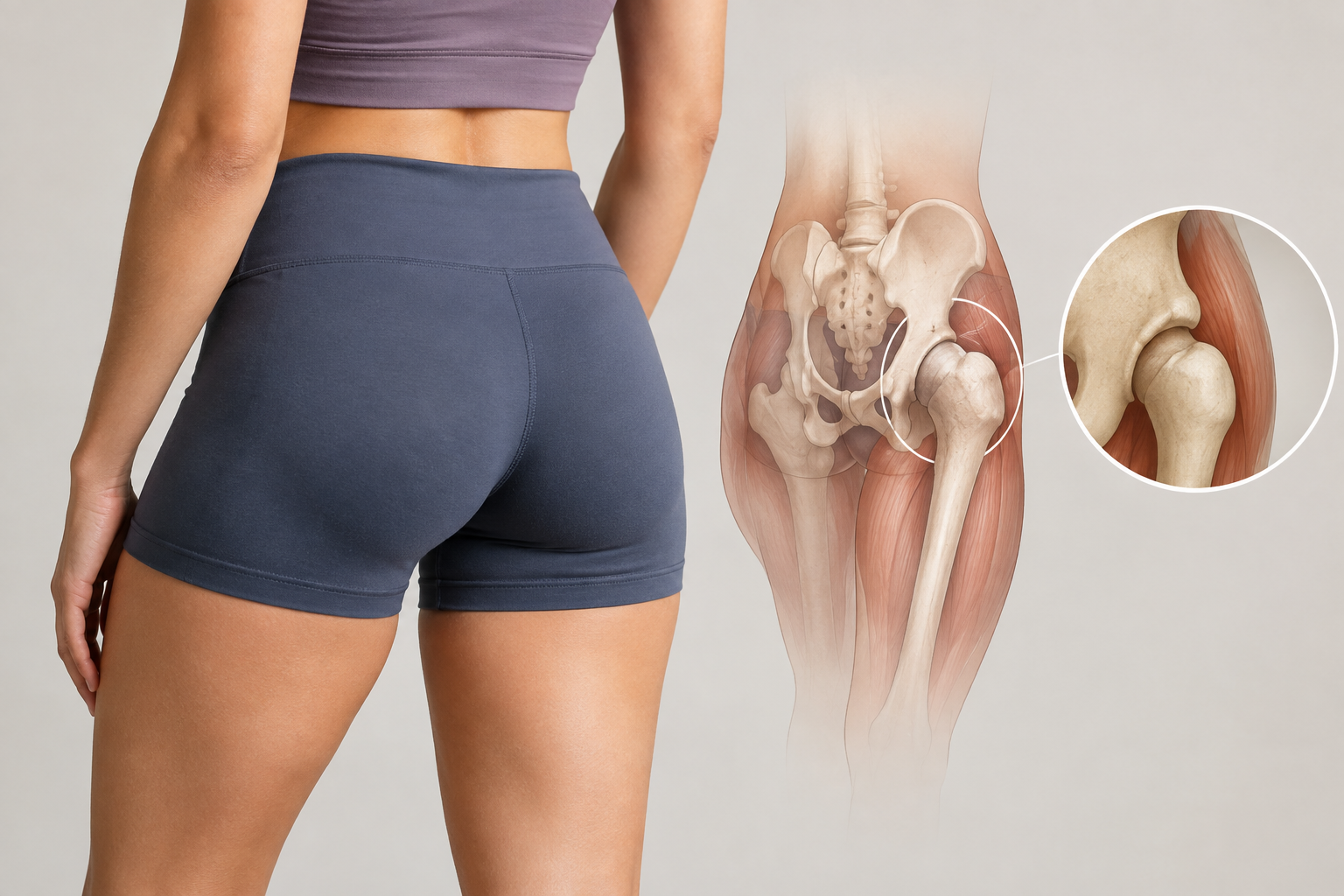
If you notice an inward curve between the outer hip and upper thigh, you may wonder why your body has that shape or whether you can change it through exercise. These natural curves are commonly called hip dips, and they are a normal part of human anatomy. Their appearance can vary widely from person to person, even among people with similar body weights and fitness levels.
The shape of your pelvis, the position of your thigh bones, muscle development, and the way your body stores fat can all influence how noticeable the curve looks. That means there is no single “ideal” hip shape and no specific measurement that determines whether your hips look right.
Rather than treating a natural body feature as something that needs fixing, it makes more sense to understand what creates it, what exercise can realistically do, and when changes in your hips might actually deserve medical attention.
What Creates the Curve Around the Hips?
The outer shape of your lower body is influenced by several structures working together. Your pelvis provides the upper framework, while the femur forms the upper part of your leg and connects to the hip joint.
Between these structures, there is a natural transition that can appear more pronounced depending on your individual skeletal proportions. Some people have a smoother-looking outline, while others have a noticeable inward curve.
Several factors can affect its visibility:
- Pelvic shape: The width and overall structure of your pelvis influence the outline of your waist and hips.
- Femur structure: The angle and proportions of the upper thigh bone can affect the contour beneath the pelvis.
- Muscle mass: Developed glute and upper-leg muscles can change the surrounding shape.
- Fat distribution: Where your body naturally stores fat can make certain curves more or less visible.
- Body composition: Changes in muscle and body fat may alter the appearance without changing the underlying skeleton.
- Genetics: Bone structure and fat distribution are strongly influenced by inherited characteristics.
This is why two people who weigh the same amount can have completely different lower-body silhouettes.
The visible curve itself is not a diagnosis or a sign that something is wrong with your hip joint. It is simply one possible variation in body shape.
Why Some People Notice Them More Than Others
Body composition gets a lot of attention when people discuss the appearance of their hips, but it is only part of the picture.
Someone with a low body-fat percentage may have a very visible indentation because less soft tissue surrounds the underlying structures. Another person may have a similar skeletal shape but more muscle or fat around the area, creating a softer transition.
Muscle development can also influence the visual appearance. Building the glutes, particularly the muscles that contribute to the upper and outer portion of the buttocks, may add fullness around the area. However, this does not mean training can remodel the bones responsible for the underlying contour.
Weight gain can similarly change the amount of soft tissue around the hips, but it cannot guarantee a particular shape. Your genetics determine where additional body fat is stored, so deliberately gaining weight simply to alter one part of your body is not a reliable strategy.
This distinction is useful because it prevents unrealistic expectations. Exercise can change muscle size, strength, posture, and body composition. It cannot completely redesign your skeletal structure.
Are Hip Dips a Sign of Poor Fitness?
No.
The presence or visibility of this natural curve does not tell you whether someone is fit, healthy, strong, or physically active. A person who trains regularly can have pronounced curves around the hips, while someone who rarely exercises may have a smoother-looking outline.
Social media can make this difficult to recognize because photographs are affected by:
- Camera angle
- Lighting
- Body position
- Clothing
- Posing
- Photo editing
- Muscle development
- Temporary changes in body composition
Even a small change in posture can make the same person’s hips look different.
Fitness should therefore be measured by useful outcomes such as strength, endurance, mobility, cardiovascular health, recovery, and the ability to perform daily activities comfortably. The outline of your hips is not a fitness test.
Can Exercise Reduce Their Appearance?
Exercise can influence the muscles surrounding your hips and thighs, so your body may look different after consistent strength training. But that is different from eliminating the anatomical curve itself.
A sensible lower-body program can develop the glutes, hamstrings, quadriceps, and muscles responsible for hip stability. Over time, increased muscle mass may create more fullness in certain areas.
Good exercises include:
| Exercise | Main training focus | Useful for |
|---|---|---|
| Hip thrusts | Glutes | Glute strength and size |
| Glute bridges | Glutes | Beginner-friendly activation |
| Squats | Glutes and quadriceps | Overall lower-body strength |
| Romanian deadlifts | Hamstrings and glutes | Hip-hinge strength |
| Bulgarian split squats | Glutes and legs | Single-leg strength |
| Step-ups | Glutes and thighs | Balance and unilateral strength |
| Side-lying leg raises | Hip muscles | Hip stability |
| Lateral band walks | Outer hip muscles | Glute and hip control |
The goal should be progressive strength development rather than trying to “erase” a specific body feature.
Hip Thrusts
Hip thrusts are particularly useful for people who want to build stronger glutes. Place your upper back against a stable bench, keep your feet firmly planted, and drive your hips upward while maintaining control.
Start with body weight if you are new to the movement. Once your technique is consistent, resistance can be added gradually.
Avoid using excessive weight simply because you want faster visual changes. Good technique and steady progression matter more than loading the exercise heavily.
Squats
Squats train multiple lower-body muscles at once. Your stance can be adjusted according to your anatomy and comfort, and there is no requirement to force yourself into an extremely deep position.
Keep the movement controlled and maintain a stable torso. If your knees, hips, or lower back hurt during squats, reduce the load and review your technique.
Romanian Deadlifts
Romanian deadlifts emphasize the hamstrings and glutes through a controlled hip-hinge movement. They are useful for developing the posterior chain and teaching your body to move efficiently through the hips.
Keep the spine stable and move your hips backward rather than simply bending forward. Start with a light weight until you understand the movement.
Bulgarian Split Squats
This single-leg exercise challenges the glutes and thighs while also demanding balance and stability. Because each leg works independently, it can expose strength differences between sides.
Use a low support if you are a beginner and hold onto something stable if balance is an issue.
A Better Way to Train for a Fuller Lower Body
If your goal is to make your lower body more muscular, focus on an overall training plan rather than searching for one exercise that targets a particular indentation.
A simple weekly approach might look like this:
- Train the lower body two or three times per week.
- Choose several compound movements such as squats, split squats, and hip hinges.
- Add one or two glute-focused exercises such as hip thrusts or bridges.
- Increase resistance gradually when your current workload becomes manageable.
- Allow recovery between hard sessions.
- Eat enough calories and protein to support muscle growth.
- Track strength improvements, not just changes in the mirror.
Muscle development takes time. Depending on genetics, training history, nutrition, sleep, and consistency, visible changes may take weeks or months.
Trying to train the same muscles every day can actually make progress harder because muscles need adequate recovery after challenging workouts.
Nutrition Matters If Muscle Growth Is the Goal
Exercise provides the training stimulus, but nutrition supplies the materials and energy needed for recovery and growth.
If you are trying to build your glutes and legs, make sure your overall diet provides enough calories and protein. Affordable foods can work perfectly well. Eggs, milk, yogurt, lentils, beans, chickpeas, potatoes, rice, oats, bananas, peanuts, and other locally available foods can contribute to a muscle-building diet.
You do not need expensive supplements or specialized “hip-shaping” products.
A useful meal structure might include:
- A protein source
- A carbohydrate source
- Vegetables or fruit
- A source of healthy fats
For someone trying to gain weight, consistently eating too little can make muscle growth difficult even with a good training routine.
However, gaining body weight does not guarantee that the added weight will go specifically to the hips or glutes. Fat distribution is largely individual.
What About Losing Weight?
Trying to lose body fat specifically from the hip area is not a reliable way to change its shape. The body does not allow you to choose exactly where fat comes off first.
Reducing overall body fat can make some anatomical features more visible rather than less visible. For that reason, aggressive dieting simply to make the hip area look different can produce the opposite result from what someone expects.
If you are already at a healthy weight, there may be little benefit in pursuing further weight loss for cosmetic reasons.
A balanced approach is usually more useful: maintain a healthy body composition, eat adequately, strength train consistently, and judge progress by performance and overall wellbeing.
Are There Treatments That Change the Shape?
Cosmetic procedures can alter the appearance of the soft tissue around the hips, but they are very different from exercise.
Some procedures use fat transfer, fillers, implants, or other techniques to change body contours. These treatments can carry risks such as infection, asymmetry, scarring, complications from anesthesia, and other procedure-specific problems.
Results may also change over time.
Anyone considering cosmetic treatment should have a detailed consultation with an appropriately qualified medical professional rather than choosing a provider based only on social media photographs or low prices.
A responsible consultation should cover:
- The exact procedure being proposed
- Expected results
- Possible complications
- Recovery time
- Long-term maintenance
- Alternatives
- Total cost
- Whether the treatment is appropriate for your anatomy
Be especially cautious about providers who promise permanent or guaranteed results.
When Hip Shape May Need Medical Attention
The appearance of a natural indentation by itself generally isn’t a reason to see a doctor. However, hip symptoms are different from cosmetic concerns.
Seek medical advice if you develop symptoms such as:
- Persistent or worsening hip pain
- Significant swelling
- A sudden change in hip shape after an injury
- Difficulty walking
- Reduced range of motion
- Weakness that affects normal activities
- Pain that repeatedly interferes with sleep or exercise
An injury, joint disorder, muscle problem, or other condition can affect how your hip feels and functions. Those issues should be assessed based on symptoms rather than the cosmetic appearance of your body.
Common Mistakes People Make
Trying to change the appearance of the hips can lead people toward ineffective or unnecessarily extreme strategies.
Doing hundreds of repetitions
More repetitions do not automatically produce better results. Muscle growth requires an appropriate combination of resistance, volume, recovery, and nutrition.
Training only one muscle
The hips work as part of a larger movement system. Training the glutes while ignoring the hamstrings, quadriceps, core, and stabilizing muscles can create an unbalanced routine.
Following social media “fixes”
Many online transformations involve posing, lighting, clothing, editing, or carefully selected angles. A before-and-after image does not necessarily demonstrate a permanent anatomical change.
Cutting calories too aggressively
Extreme dieting can reduce energy, impair training performance, and make it harder to maintain muscle.
Expecting rapid changes
Muscle tissue develops gradually. A program that you can follow consistently for several months is usually more useful than a dramatic routine you abandon after two weeks.
How to Build Stronger, Healthier Hips
You do not need a complicated program to improve hip strength.
A balanced lower-body routine could include a squat pattern, hip-hinge movement, single-leg exercise, glute-focused movement, and a hip-stability exercise.
For example:
Workout A
- Squats: 3 sets
- Hip thrusts: 3 sets
- Romanian deadlifts: 3 sets
- Lateral band walks: 2–3 sets
Workout B
- Bulgarian split squats: 3 sets
- Glute bridges: 3 sets
- Step-ups: 3 sets
- Side-lying leg raises: 2–3 sets
Train these sessions on separate days and adjust the number of sets and resistance according to your experience.
If you are new to strength training, learning correct technique should come before adding heavy resistance. A qualified trainer or physical therapist can also help if you have pain, movement limitations, or uncertainty about exercise form.
Frequently Asked Questions
Are hip dips completely normal?
Yes. The indentation between the pelvis and upper thigh can be a normal variation in body structure. Its visibility differs according to skeletal proportions, muscle development, and fat distribution. Having a more noticeable curve does not automatically indicate poor fitness, unhealthy weight, or a problem with the hip joint.
Can squats get rid of hip dips?
Squats cannot change the underlying shape of your pelvis or femur. They can strengthen and build the glutes and thighs, which may alter the overall appearance of your lower body. If your goal is stronger or more muscular legs and glutes, squats can be a valuable part of your routine.
Does gaining weight make the curve disappear?
Not necessarily. Gaining weight can increase soft tissue in different areas, but your genetics determine where much of that weight is stored. Some people may notice a softer outline after gaining weight, while others may see little difference in that particular area.
Can losing weight make the indentation more noticeable?
It can. When body fat decreases, underlying skeletal contours may become more visible. However, everyone’s fat distribution is different, so there is no guaranteed change. Weight loss should be pursued for appropriate health or body-composition goals rather than as a guaranteed method of changing one specific part of the body.
Which exercises are best for building the surrounding muscles?
Hip thrusts, squats, Romanian deadlifts, split squats, step-ups, and glute bridges are useful choices. Exercises that strengthen the outer hip muscles can also support stability. The best routine combines several movement patterns and gradually increases training difficulty instead of relying on one exercise.
Do men have this body shape too?
Yes. The contour can appear in people of any sex. Differences in pelvic structure, femur shape, muscle mass, and fat distribution affect how visible it becomes. It should not be considered an exclusively female body feature.
Are cosmetic procedures a permanent solution?
No procedure should be assumed to provide a guaranteed permanent result. Fat transfer and other contouring treatments have risks, recovery requirements, and variable outcomes. Anyone considering cosmetic treatment should discuss the specific procedure with a properly qualified medical professional and understand both its benefits and potential complications.
Should I worry if the area suddenly becomes painful?
A new painful symptom deserves more attention than a naturally occurring body contour. Sudden pain, swelling, weakness, difficulty walking, or reduced movement can have many possible causes, including injury or joint problems. If symptoms persist, worsen, or interfere with normal activities, seek an appropriate medical evaluation.
Final Thoughts
The shape of your hips is influenced by anatomy, genetics, muscle, and fat distribution. Exercise can make your glutes and legs stronger and more developed, but it cannot completely redesign the underlying bones that determine your natural contours.
If you have hip dips, there is no health requirement to eliminate them. A better goal is to build strength, maintain mobility, eat well, recover properly, and choose fitness targets that improve how your body functions.
Your body does not need to match a social-media trend to be healthy or attractive. Focus on what you can actually control: your habits, your strength, your nutrition, and the way you care for your body over time.