
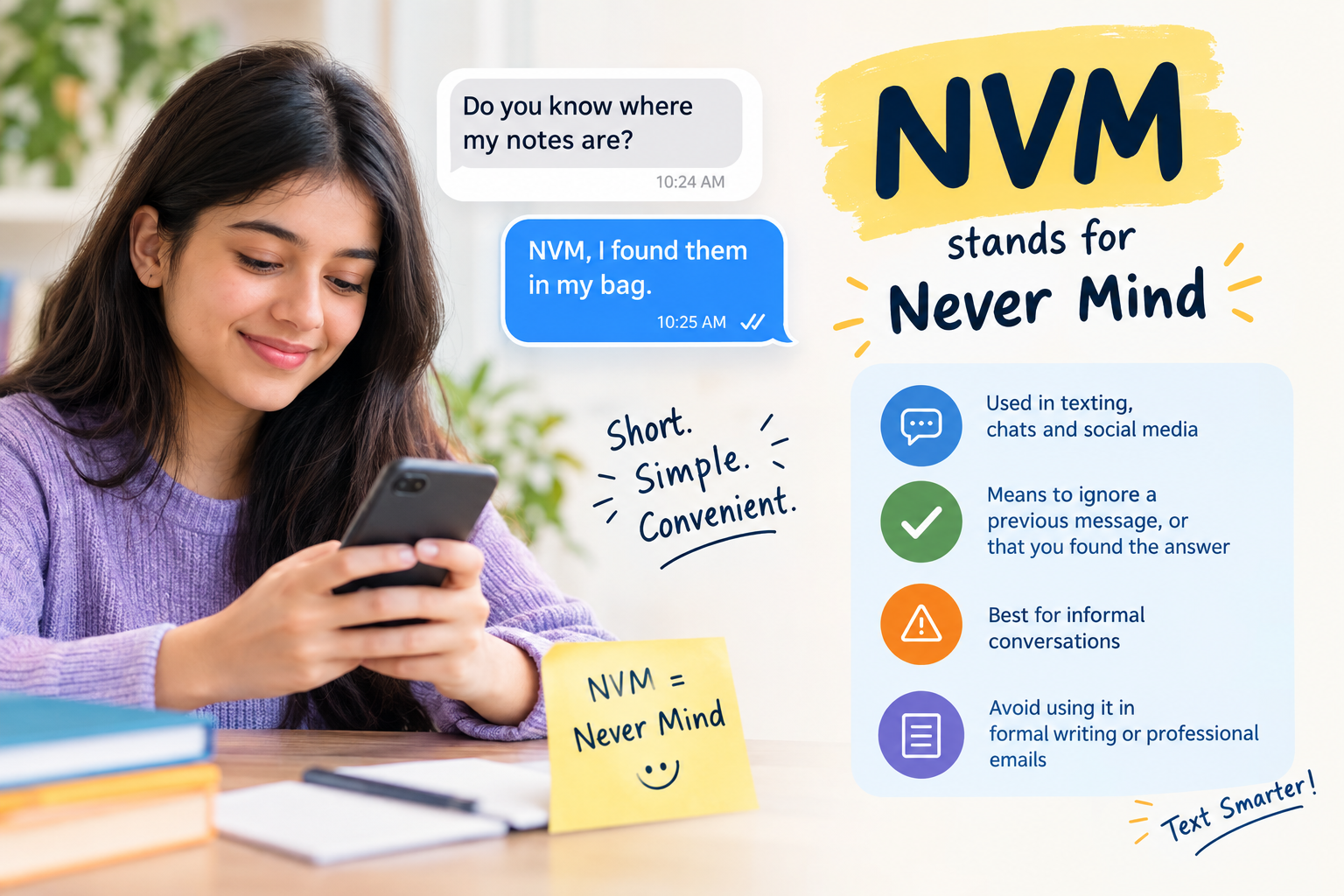
If you have seen nvm meaning in a WhatsApp message, Instagram comment, text, or online conversation, you may have wondered what the three letters actually mean. NVM is a common internet abbreviation for “Never Mind.” People use it when they want someone to ignore something they just said, asked, or mentioned. It can also signal that a person has solved a problem on their own or changed their mind about continuing a conversation.
Although NVM is simple, its tone can change depending on the situation. Understanding when to use it can help you communicate more naturally online without accidentally sounding dismissive.
What Does NVM Stand For?
NVM stands for Never Mind. It is an informal abbreviation used mainly in digital communication.
The phrase “never mind” has several closely related meanings. Someone might use it to:
- Withdraw a question
- Tell another person to ignore a previous message
- Indicate that a problem has already been solved
- Stop explaining something
- Change the subject
- Show that something is no longer important
For example:
“Can you send me the address? NVM, I found it.”
Here, the person initially needed help but discovered the answer before the other person could respond.
NVM is particularly common because short abbreviations make texting faster. Instead of typing “Never mind,” a person can simply write three letters.
NVM Meaning in Text Messages
In texting, NVM generally means that the previous message or request is no longer relevant.
The exact meaning depends on the surrounding conversation. Consider these examples:
Example 1: Solving a problem
“Do you know where my charger is? NVM, I found it.”
The sender no longer needs an answer.
Example 2: Cancelling a request
“Can you bring my notebook tomorrow? NVM, I don’t need it anymore.”
The original request has been withdrawn.
Example 3: Correcting yourself
“The meeting starts at 4. NVM, I just checked—it starts at 5.”
Here, NVM introduces a correction.
Example 4: Ending a question
“Can I ask you something? NVM, it’s not important.”
The speaker decides not to continue with the question.
So, while the basic meaning remains “Never Mind,” the abbreviation can perform slightly different functions in a conversation.
Why Do People Write NVM Instead of Never Mind?
Online communication has encouraged people to use shorter expressions. Typing NVM takes only a moment, making it convenient for fast conversations.
There are several reasons people prefer the abbreviation:
- It is quick. Three letters are easier to type than the full phrase.
- It is widely understood. Most frequent internet users recognize it.
- It fits casual conversations. Texting often uses shortened words and abbreviations.
- It works well in quick corrections. Someone can send another message immediately after realizing they no longer need help.
- It has become familiar internet slang. Like BRB, IDK, BTW, and LOL, NVM is recognizable in many online communities.
The abbreviation is not necessarily better than the full phrase. It simply suits situations where informal, quick communication is expected.
Common Situations Where NVM Is Used
NVM can appear in many everyday digital conversations. Its most natural setting is an informal chat between people who already understand one another.
When You Find an Answer Yourself
This is one of the most common uses.
“Do you know the Wi-Fi password? NVM, I found it on the router.”
The person initially needed assistance but no longer does.
When You Change Your Mind
Someone may begin asking for something and then decide against it.
“Can you send me that picture? NVM, I already have it.”
The abbreviation tells the recipient that the request can be ignored.
When a Question Is No Longer Relevant
For example:
“What time are you coming? NVM, Ahmed just told me.”
The sender has obtained the information elsewhere.
When You Make a Small Mistake
A person may notice an error immediately after sending a message.
“The appointment is Tuesday. NVM, it’s actually Wednesday.”
In this situation, NVM helps introduce the correction naturally.
When You Decide Not to Explain Something
Sometimes people begin a thought and then decide that further explanation is unnecessary.
“I wanted to tell you why I left early, but NVM.”
This use can sound more emotional depending on the conversation, so context matters.
Is NVM Polite or Rude?
NVM itself is not automatically rude. However, the way it is used can affect how the message feels.
A friendly conversation might make the abbreviation seem completely normal:
“Can you check the price for me? NVM, I found it online 😂”
The same abbreviation can sound dismissive in another situation:
“Why did you do that?”
“NVM.”
Here, the response may suggest frustration or unwillingness to continue the discussion.
Tone becomes especially difficult to judge in text because written messages do not include facial expressions, voice, or body language. A short reply can therefore be interpreted differently by different people.
If you want to make your message sound warmer, you can add a few words:
- “NVM, I figured it out. Thanks!”
- “Never mind, I found the answer.”
- “NVM, no worries.”
- “It’s okay, I got it now.”
These versions reduce the chance of sounding cold or annoyed.
When Should You Avoid NVM?
NVM is best reserved for informal communication. It may not be appropriate in every environment.
Avoid using the abbreviation in situations where professional or formal language is expected, such as:
- Job applications
- Formal business emails
- Academic essays
- Official letters
- University applications
- Reports
- Formal customer communication
- Professional proposals
For example, instead of writing:
“NVM, I found the document.”
in a professional email, you could write:
“Never mind, I have found the document. Thank you for your assistance.”
The second version is clearer and more appropriate for formal communication.
The key difference is not that NVM is incorrect English. It is an informal abbreviation, so the communication setting determines whether it fits.
NVM Meaning in Social Media Conversations
On social media, NVM is frequently used in comments, direct messages, group chats, and replies.
A person may use it after realizing that their question has already been answered. It can also appear when someone changes their mind during a discussion.
For example:
“Does anyone know if the store is open today?”
Someone might reply:
“NVM, I checked their page. It’s closed.”
The abbreviation makes the exchange quick and casual.
On platforms where people communicate rapidly, abbreviations such as NVM can help keep conversations moving without requiring complete sentences every time.
NVM vs. Never Mind
The meaning of NVM and “Never Mind” is essentially the same, but their style is different.
| Expression | Style | Common Use |
|---|---|---|
| NVM | Very informal | Texts, chats, social media |
| Never mind | Neutral to informal | Conversation, messages, general writing |
| Please disregard | Formal | Business or professional communication |
| No longer necessary | Formal | Emails, notices, workplace messages |
| It’s okay, I found it | Friendly and clear | Casual or professional settings |
“NVM” feels shorter and more conversational. “Never mind” is more versatile because it can be used in speech and writing. Formal alternatives are better when communicating with clients, teachers, employers, or officials.
How to Use NVM Correctly
Using NVM is simple, but its position in a message can influence clarity.
Put It Before the Correction
“NVM, I just checked the schedule.”
This immediately tells the reader that the earlier question does not need an answer.
Use It After an Original Question
“Do you have the notes? NVM, Sarah sent them to me.”
This clearly shows why the request has been cancelled.
Add Context When Necessary
A single “NVM” can sometimes be confusing.
Compare:
“NVM.”
with:
“NVM, I found the file.”
The second message is more informative because the reader knows what changed.
Avoid Overusing It
If you repeatedly send messages such as “NVM,” “forget it,” or “never mind,” the other person may think you are frustrated or avoiding the conversation.
Use it when there is a genuine reason to withdraw or correct the previous message.
Examples of NVM in Everyday English
Here are several natural examples:
- “Can you call me later? NVM, I can call you.”
- “Do you have today’s homework? NVM, I got it from Ali.”
- “What was her name again? NVM, I remember now.”
- “Can you help me with this question? NVM, I solved it.”
- “Are you coming to the event? NVM, I just saw your message.”
- “Send me the address when you can. NVM, Google Maps has it.”
- “I thought the shop closed at 8. NVM, it closes at 9.”
- “Can you explain that again? NVM, I understand now.”
These examples show that the abbreviation usually appears when the sender no longer needs the response they originally wanted.
NVM and Similar Internet Abbreviations
People who use NVM often encounter many other shortened expressions online. Learning them can make digital conversations easier to understand.
| Abbreviation | Meaning | Typical Use |
|---|---|---|
| NVM | Never Mind | Withdrawing or correcting a thought |
| IDK | I Don’t Know | Showing uncertainty |
| BTW | By The Way | Introducing additional information |
| BRB | Be Right Back | Temporarily leaving a conversation |
| FYI | For Your Information | Sharing useful information |
| IMO | In My Opinion | Giving a personal opinion |
| TBH | To Be Honest | Introducing an honest statement |
| ASAP | As Soon As Possible | Requesting something quickly |
| LOL | Laughing Out Loud | Showing amusement |
| TTYL | Talk To You Later | Ending a conversation temporarily |
Not all abbreviations have exactly the same level of informality. Some, such as ASAP and FYI, are also common in workplace communication, while NVM is much more strongly associated with casual digital conversations.
How NVM Can Change Tone
One interesting feature of NVM is that the same abbreviation can communicate different emotions.
Neutral
“NVM, I found the information.”
This simply means the sender solved the problem.
Friendly
“NVM 😂 I figured it out.”
The emoji makes the message feel relaxed and humorous.
Frustrated
“NVM. Forget it.”
Adding “forget it” and a full stop can make the message appear irritated.
Disappointed
“NVM, I’ll do it myself.”
This may imply that the person expected assistance but no longer wants it.
Because digital communication lacks vocal tone, punctuation and surrounding words can affect how NVM is interpreted.
Should Students Use NVM in School Writing?
Students may use NVM when chatting with friends, but it should generally be avoided in formal schoolwork.
An essay, assignment, examination answer, or academic report should use complete words and sentences. For example:
Informal message:
“NVM, I got the answer.”
Formal version:
“Never mind. I have found the answer.”
For an academic essay, it would be even better to write a complete sentence that explains the situation rather than relying on an abbreviation.
This distinction is useful because internet shorthand belongs mainly to informal communication. Knowing when to switch between casual and formal English is an important communication skill.
NVM Meaning and Digital Communication Etiquette
Using abbreviations effectively is not just about knowing what they stand for. It is also about understanding the person and situation.
Before sending NVM, consider:
- Who are you talking to?
- Is the conversation casual or professional?
- Could the message sound dismissive?
- Does the recipient know common texting abbreviations?
- Would a few additional words make your meaning clearer?
For close friends, “NVM, got it 😂” may be perfectly natural. For a teacher, manager, customer, or client, a clearer phrase is usually safer.
When there is any possibility of misunderstanding, writing the full phrase or explaining what you mean takes very little extra effort.
A Quick Guide to Using NVM
If you want a simple rule, think of NVM as a shortcut for telling someone that your previous statement no longer requires attention.
Use it when:
- You found the answer yourself.
- You no longer need someone’s help.
- You changed your mind.
- Your previous question is no longer relevant.
- You want to correct something you just said.
Avoid it when:
- Writing a formal document.
- Communicating with someone in an official setting.
- The message could sound dismissive.
- The recipient may not understand internet abbreviations.
A useful alternative is simply to write “Never mind” when you want to retain a casual tone but make the message clearer.
Frequently Asked Questions
1. What is the full form of NVM?
NVM stands for “Never Mind.” It is an informal abbreviation commonly used in texting, instant messaging, social media, and online conversations. People generally use it when they want someone to ignore a previous question, statement, or request. It can also indicate that they have found an answer themselves or changed their mind about continuing a particular topic.
2. What does NVM mean in texting?
In texting, NVM usually means that something mentioned earlier is no longer necessary or relevant. For example, someone might ask, “Do you know the address?” and then send, “NVM, I found it.” The sender has solved the problem, so the other person does not need to respond to the original question.
3. Is NVM considered slang?
Yes, NVM is generally considered an informal internet abbreviation or texting shorthand. It is common in casual digital conversations but is not normally appropriate for formal essays, official documents, or professional correspondence. The complete phrase “Never mind” is more flexible and can be used in a wider range of situations.
4. Can I use NVM in a professional email?
It is better to avoid NVM in professional emails, particularly when communicating with clients, employers, teachers, or unfamiliar contacts. Instead, use a clear phrase such as “Never mind, I have found the information” or “Please disregard my previous message.” These alternatives communicate the same idea while maintaining a professional tone.
5. Is NVM rude?
NVM is not inherently rude, but it can sound dismissive depending on the context. “NVM, I found it. Thanks!” sounds friendly, while simply replying “NVM” during a serious discussion might seem irritated or abrupt. Adding a short explanation or polite phrase can make your intention much clearer.
6. What is the difference between NVM and NM?
Both NVM and NM can represent “Never Mind” in informal online communication. NVM is generally more recognizable because it directly corresponds to the first letters of “Never Mind.” NM can have other meanings in different contexts, so NVM may be clearer when communicating online.
7. Can NVM be used in an English exam?
NVM should generally not be used in a formal English examination unless the question specifically asks about texting language, abbreviations, or informal communication. In normal essays and written answers, use complete words and grammatically appropriate sentences. Knowing nvm meaning is useful, but recognizing when not to use the abbreviation is equally important.
8. How do you pronounce NVM?
When people say the abbreviation aloud, they may pronounce the individual letters “N-V-M.” However, in everyday speech, people normally say the full phrase “never mind” rather than treating NVM as a spoken word. The abbreviation is primarily designed for written digital communication rather than ordinary conversation.
Final Thoughts
NVM is a simple but widely recognized abbreviation that means “Never Mind.” It is especially useful in texting and social media when someone wants to withdraw a question, correct a previous thought, or explain that they have solved an issue themselves.
Understanding nvm meaning also involves understanding tone. The abbreviation works naturally among friends and in casual chats, but complete words are usually a better choice for academic, workplace, and official communication. When used in the right setting, NVM keeps conversations short, clear, and convenient without needing a long explanation.