
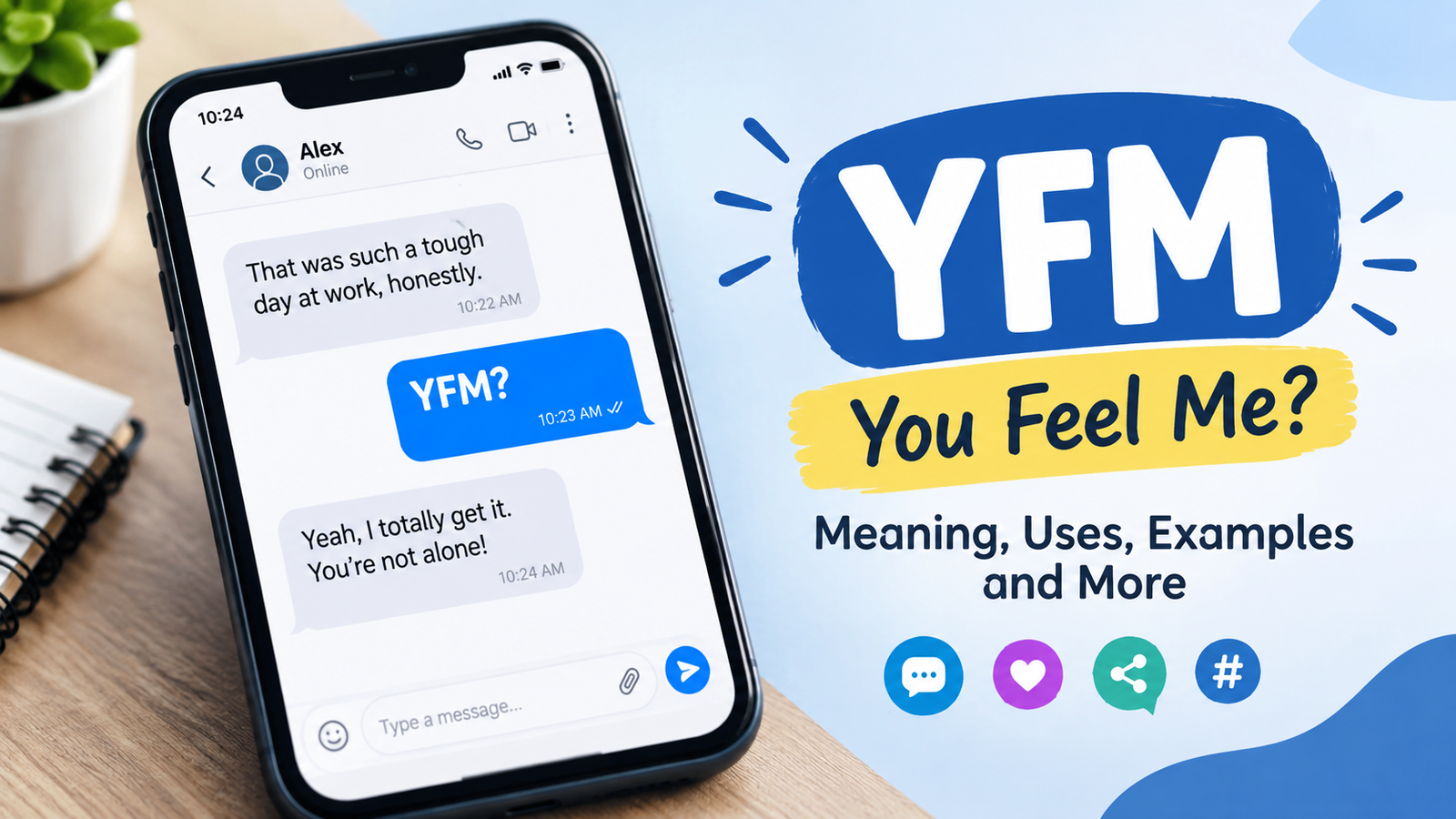
If you have seen yfm meaning in a text message, comment, caption, or social media conversation, you may have wondered what the three letters stand for. In most casual conversations, YFM means “You Feel Me?” It is a quick way to ask whether another person understands your point, relates to your feelings, or agrees with what you are saying.
The expression is informal and usually appears between friends or people who already have a relaxed style of communication. Its meaning can depend slightly on the sentence around it, but the basic idea stays the same: Do you understand what I mean?
The Basic Meaning Behind YFM
YFM is a shortened form of “You Feel Me?” Rather than literally asking whether someone can physically feel something, the phrase asks whether they understand or connect with an idea.
For example:
“I’ve been working all week and I just want to sleep this weekend, YFM?”
The person is not asking whether the other person can physically feel them. They are saying something like:
“You understand what I mean, right?”
Depending on the conversation, YFM can also carry meanings such as:
- Do you understand?
- Can you relate?
- Do you agree?
- Do you see my point?
- Do you know what I’m saying?
- Are you with me on this?
The expression is particularly useful when someone wants confirmation without making the conversation sound formal.
Where the Expression Comes From
“You feel me?” has a much longer history than texting and social media. The phrase became strongly associated with African American Vernacular English and American hip-hop and urban speech. From there, it became familiar to wider audiences through music, entertainment, movies, television, and everyday conversation.
As online communication developed, people began shortening common expressions to make typing faster. Acronyms such as YFM fit naturally into text messages, instant messaging, comments, and social platforms.
That does not mean every person who uses YFM is intentionally referencing its cultural origins. For many modern internet users, it simply functions as familiar slang.
The expression also follows a broader pattern in digital communication. People often turn longer phrases into short forms, especially when the original expression is already widely understood.
How YFM Is Used in Texting
The easiest way to understand the acronym is to look at how it works inside an ordinary conversation.
Checking for Understanding
Someone may explain a situation and add YFM at the end:
“My boss keeps changing the deadline, yfm?”
Here, YFM means:
“You understand why I’m frustrated, right?”
Looking for Agreement
It can also ask someone to agree with a viewpoint:
“That restaurant is way too expensive for what they serve, yfm?”
The speaker is inviting the other person to share the same opinion.
Showing Relatability
YFM can create a sense of connection between two people.
“Sometimes you just need a day away from everyone, yfm?”
This usage is less about proving that the other person agrees and more about asking whether they can relate to the feeling.
Adding Emphasis
Sometimes YFM is simply used to make a statement feel more conversational:
“I stayed up all night finishing that project, yfm.”
The acronym makes the message sound like spoken conversation rather than formal writing.
Examples of YFM in Different Conversations
Context is the key to understanding slang. Here are several examples showing how the same expression can work in different situations.
| Example | Likely meaning |
|---|---|
| “I need a break from everything, yfm?” | Do you understand how I feel? |
| “That exam was impossible, yfm?” | Did you find it difficult too? |
| “I’m saving money instead of going out, yfm.” | You understand my decision. |
| “Nobody wants to wait two hours for food, yfm?” | You agree with me, right? |
| “I just want some peace today, yfm?” | Can you relate to that feeling? |
Notice that the basic definition does not change. The surrounding message determines whether the speaker is mainly asking for understanding, agreement, or emotional connection.
YFM Meaning Can Depend on Context
Acronyms can sometimes be confusing because three letters may represent multiple phrases. YFM is a good example.
In casual texting, “You Feel Me?” is generally the interpretation when the surrounding conversation is informal and personal.
However, YFM can also refer to other names or organizations. One known example is YFM, a South African youth radio station. In entertainment, YFM has also been used as an abbreviation connected with Your Favorite Martian, a virtual music project.
That is why you should not automatically assign one definition to every appearance of YFM.
Consider the context:
- A friend sends “I’m exhausted, YFM?” → likely “You Feel Me?”
- A website discusses a radio broadcaster called YFM → likely the station
- An article discusses an animated music project → possibly Your Favorite Martian
The words around the acronym usually make the intended meaning clear.
Is YFM Appropriate for Everyone?
YFM is generally considered casual slang rather than formal English. There is nothing inherently offensive about the expression when it is used in its common sense.
Still, appropriateness depends on where you use it.
YFM works naturally in:
- Text messages
- Casual chats
- Social media comments
- Private messages
- Informal captions
- Conversations with friends
It is usually better to avoid it in:
- Formal business emails
- Academic assignments
- Official applications
- Professional reports
- Formal customer communication
For professional writing, expressions such as “Do you understand?” or “Does that make sense?” are clearer and more appropriate.
The issue is not that YFM is a bad word. It is simply informal language designed for relaxed communication.
Why People Use Short Forms Like YFM
Online conversations have changed the way people communicate. Acronyms allow users to express familiar phrases quickly without typing every word.
The popularity of short forms comes from several factors.
Faster Communication
Typing “You Feel Me?” takes longer than entering three letters. In fast-moving chats, abbreviations can make communication more efficient.
Informal Tone
YFM sounds more relaxed than a formal question such as “Do you understand my perspective?”
Shared Internet Language
People who frequently communicate online become familiar with abbreviations. Once a term becomes recognizable, users do not need to spell it out.
Emotional Connection
Expressions such as “You feel me?” are conversational by nature. The shortened form can preserve that friendly feeling while making the message brief.
YFM Compared With Similar Slang
YFM is not the only expression people use to check whether someone understands them. Several other phrases perform a similar function.
| Expression | Meaning | Tone |
|---|---|---|
| YFM | You Feel Me? | Very casual |
| WYD | What You Doing? | Casual |
| IMO | In My Opinion | Casual |
| IKR | I Know, Right? | Casual |
| Do you get me? | Do you understand? | Conversational |
| You know what I mean? | Do you understand my point? | Conversational |
The closest alternatives are “You know what I mean?” and “Do you get me?” Both can communicate a similar idea without using an acronym.
One difference is that YFM often carries a stronger sense of relating to someone’s experience. If someone says, “I have been dealing with too much lately, yfm?” they may be asking not only whether you understand the words but whether you understand the feeling behind them.
How to Respond When Someone Says YFM
If someone sends you YFM, your response depends on whether you actually understand or agree.
If you understand, you could reply:
- “Yeah, I get you.”
- “I feel you.”
- “Exactly.”
- “I know what you mean.”
- “Yeah, that makes sense.”
If you relate personally, you could say:
- “Yeah, I’ve been there too.”
- “Honestly, same.”
- “I feel you on that.”
If you do not understand, there is nothing wrong with asking for clarification:
- “What do you mean?”
- “Yeah, but explain what you mean.”
- “I’m not sure I get you.”
There is no special response required. YFM is simply part of the conversation and should be answered according to the message surrounding it.
YFM in Social Media Comments and Captions
Social media has helped casual abbreviations spread between different groups and communities. YFM may appear in comments, captions, short posts, memes, or direct messages.
For example:
Here, the original poster is asking whether others relate to the idea.
It can also appear without a question mark:
“I’m just focused on myself right now yfm.”
In that case, the speaker may be using it as a conversational emphasis rather than asking for a literal answer.
Punctuation is not always reliable in social media writing. People frequently leave out question marks, periods, and other punctuation, so the surrounding words matter more than the exact formatting.
Does YFM Have a Hidden or Negative Meaning?
In its common texting usage, YFM does not inherently indicate something dangerous, inappropriate, or secret. It is normally just a shortened version of “You Feel Me?”
However, as with almost any abbreviation, context matters. A three-letter acronym can have different meanings in different communities, industries, or conversations.
If you encounter YFM and are unsure about it, look at:
- The sentence where it appears.
- The relationship between the people communicating.
- Other words used around the acronym.
- Whether the conversation is about slang, music, media, or an organization.
- Whether the acronym is being used repeatedly in the same way.
This approach is more reliable than assuming every occurrence has exactly the same definition.
Common Mistakes When Interpreting YFM
People unfamiliar with internet slang can sometimes take acronyms too literally. That can create unnecessary confusion.
One common mistake is assuming “feel” refers to physical touch. In this expression, it normally means understanding, relating to, or connecting with someone’s idea or emotion.
Another mistake is treating YFM as formal English. It is better understood as conversational slang.
A third mistake is assuming that every use has the same meaning. Acronyms can represent different things in different contexts, so the surrounding material should always be considered.
A Simple Way to Decode It
When you see YFM in a message, mentally replace it with:
“Do you understand what I mean?”
Then check whether that interpretation makes sense with the rest of the sentence.
If it does, you have probably found the intended meaning.
When Should You Use YFM?
If you are chatting with friends or posting something informal, YFM can make your message feel relaxed and conversational.
For example:
“I’m tired of explaining the same thing again, yfm?”
That sounds natural in a casual conversation.
For a formal audience, however, write the full thought:
“I hope you understand what I mean.”
This small adjustment makes your communication clearer and more professional.
A useful rule is simple: match your language to your audience. Slang can be perfectly appropriate in a personal chat but out of place in an academic or professional document.
YFM and the Evolution of Internet Slang
Internet language changes quickly. Some abbreviations remain popular for years, while others disappear as platforms and communication habits change.
YFM belongs to a broader group of expressions that moved from spoken language into digital communication. Similar processes happened with phrases that later became abbreviations such as LOL, BRB, IDK, and IMO.
What makes these expressions interesting is that they do more than save typing time. They can also communicate tone.
Writing: “Do you understand what I mean?”
sounds direct and complete.
Writing: “YFM?”
feels shorter, more casual, and more conversational.
That difference is one reason slang continues to be useful even when people have no problem typing the full sentence.
Quick Guide to YFM
If you want the simplest explanation, remember these points:
- YFM usually means “You Feel Me?”
- It asks whether someone understands or relates to an idea.
- It can sometimes suggest agreement or shared feelings.
- It is mainly used in informal communication.
- It commonly appears in texts, DMs, comments, and social media.
- It is not normally offensive or harmful by itself.
- Other meanings exist, so context should always be checked.
- Formal writing should generally use clearer standard English instead.
Frequently Asked Questions
What does YFM mean in a text?
In most text conversations, YFM means “You Feel Me?” It is a casual way of asking whether someone understands, agrees with, or relates to what you just said. For example, “I just need some time alone, YFM?” could mean “You understand how I feel, right?” The exact shade of meaning depends on the conversation and the relationship between the people involved.
What does YFM mean on social media?
On social media, YFM usually has the same meaning: “You Feel Me?” People use it in captions, comments, posts, and direct messages to ask whether others understand or relate to their statement. It can also be used as conversational emphasis without expecting a detailed response. Because social platforms contain many communities, always consider the surrounding content before deciding what an acronym means.
Is YFM a bad word?
No. In its common slang usage, YFM is not a swear word or inherently offensive expression. It is normally shorthand for “You Feel Me?” and is used to seek understanding or agreement. The tone depends on the conversation. Although the acronym itself is generally harmless, other meanings may exist in specific communities or organizations, so context remains important when interpreting it.
What should I reply when someone says YFM?
You can respond naturally based on whether you understand or relate to their point. “Yeah, I get you,” “Exactly,” “I feel you,” or “I know what you mean” can all work. If you do not understand the message, simply ask the person to explain. There is no fixed response because YFM functions as part of ordinary casual conversation rather than as a formal question.
Does YFM mean “you feel me” or “you feel me?”
Both refer to the same expression. The capitalization and punctuation can vary because internet slang is usually written informally. YFM is the acronym formed from the first letters of “You Feel Me?” The question mark may be included when the writer is directly asking for confirmation, but many people leave punctuation out in casual messages.
Can YFM have another meaning?
Yes. Although “You Feel Me?” is the common interpretation in casual texting, YFM can represent other names or organizations. For example, it can refer to a South African radio station or appear in entertainment-related contexts. The correct interpretation therefore depends on where you found it. Looking at the surrounding words is usually enough to distinguish the meanings.
Is YFM appropriate in professional messages?
Usually, it is better to avoid YFM in formal communication. It is casual slang and may be unfamiliar to some readers. In a professional email or report, phrases such as “Does that make sense?” or “Do you understand my point?” are clearer. Using standard language also helps avoid ambiguity when communicating with clients, employers, teachers, or other formal audiences.
Why do people use YFM instead of writing the whole phrase?
People use YFM because it is short, familiar, and conversational. Internet users often abbreviate common expressions to make messages quicker to type. The acronym can also preserve the relaxed feeling of spoken slang. Instead of writing “You feel me?” every time, three letters communicate the same basic idea to readers who already recognize the expression.
Final Thoughts
Understanding yfm meaning is fairly simple once you recognize the conversational context. In most texts and social media messages, it is shorthand for “You Feel Me?” and asks whether another person understands, relates to, or agrees with what has been said.
The expression is informal and usually harmless, but its meaning can change when it appears in a different setting. The best approach is to read the complete message rather than interpreting the three letters in isolation. Once you know the context, YFM is usually easy to understand and respond to naturally.