
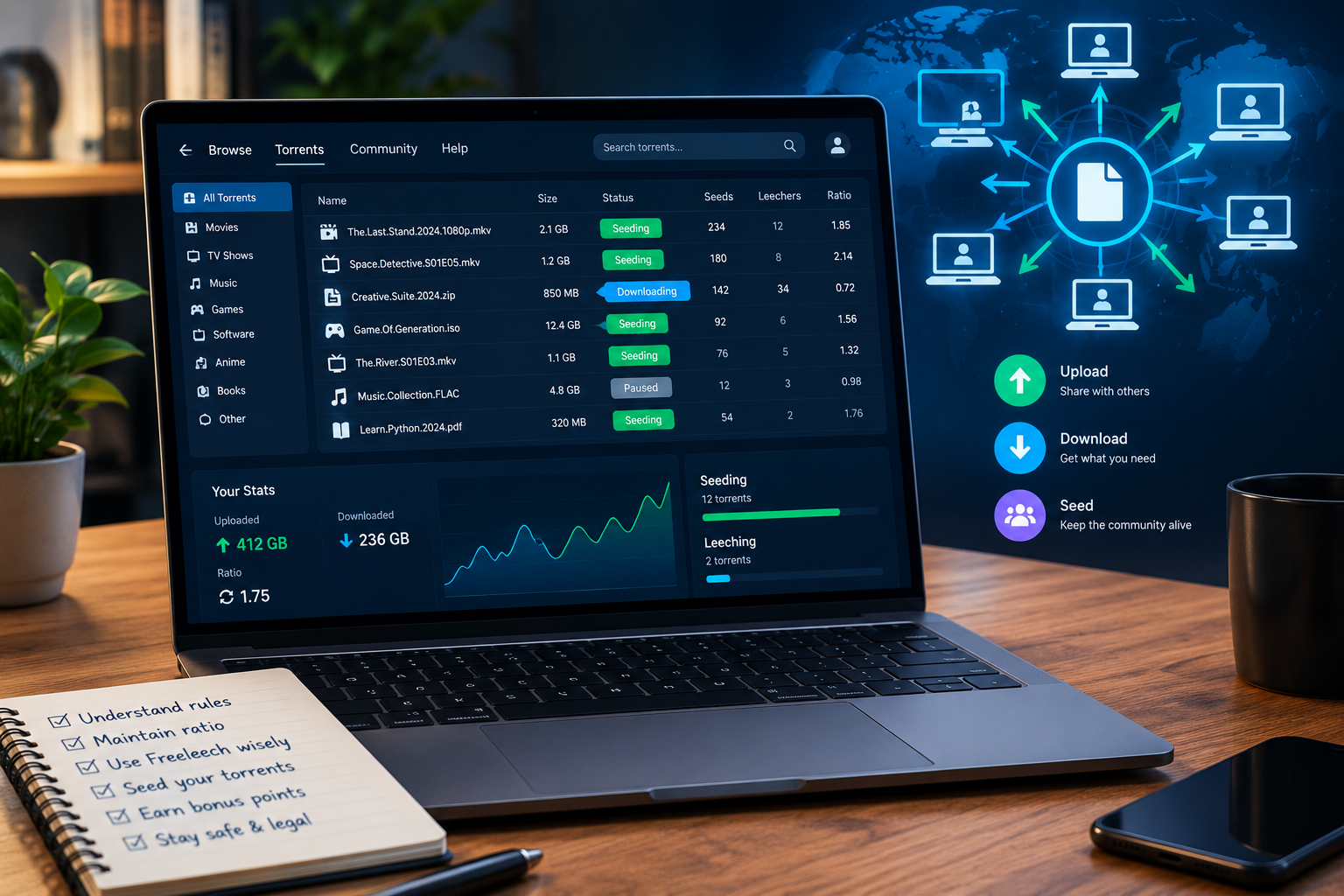
Private torrent trackers work differently from ordinary torrent websites. Instead of simply searching for a file and downloading it, users generally participate in a community where downloading and uploading are connected through a ratio system. That structure can make the experience more organized, but it also creates rules that new members need to understand.
IPTorrents is one example of this type of tracker. It provides a large catalog organized into categories and uses account rules, seeding requirements, and reward mechanisms to encourage users to contribute bandwidth. Before using a private tracker, it helps to understand how ratios work, what Freeleech means, why seeding matters, and what can cause account problems.
This guide explains the main concepts in straightforward language and highlights practical considerations for anyone researching IPTorrents or private torrent communities.
What Makes a Private Torrent Tracker Different?
A torrent tracker helps peers discover one another so they can exchange pieces of files. Public torrent indexes generally allow anyone to access their listings, while private trackers restrict membership and apply additional rules.
The biggest difference is the expectation of participation.
On a private tracker, downloading is usually only one part of the process. Users are expected to keep torrents available for other members after completing a download. This process is called seeding.
A private tracker may also monitor:
- How much data a member downloads
- How much data they upload
- Individual torrent ratios
- Overall account ratio
- Seeding activity
- Hit-and-run activity
- Account warnings
- Community rule violations
The purpose of these systems is to prevent a community from becoming dominated by users who only download. If everyone downloaded without contributing upload bandwidth, popular files could eventually become difficult for other members to obtain.
How IPTorrents Uses Ratio-Based Participation
The ratio is one of the first concepts a new private-tracker user should understand.
A simple ratio is calculated by comparing uploaded data with downloaded data. For example, if someone downloads 10 GB and later uploads 10 GB, the transfer ratio is 1.00.
If they upload only 5 GB after downloading 10 GB, the ratio is 0.50.
| Downloaded | Uploaded | Example Ratio |
|---|---|---|
| 10 GB | 10 GB | 1.00 |
| 10 GB | 5 GB | 0.50 |
| 20 GB | 30 GB | 1.50 |
| 50 GB | 25 GB | 0.50 |
The exact rules applied by a private tracker can differ, so users should always read the current rules associated with their account.
Ratio management becomes especially important when downloading large files. A fast download followed by little seeding can leave an account with a poor ratio. Someone with a slower internet connection may therefore need to think about upload opportunities before starting large downloads.
Why Seeding Matters
Seeding means continuing to share a completed torrent with other peers.
When a torrent finishes downloading, the client can continue uploading pieces to people who are still downloading it. This is how a peer-to-peer network remains useful.
A practical approach is to leave completed torrents available when possible rather than immediately removing them. Longer seeding can help improve an account’s upload statistics while also contributing bandwidth to the community.
Users should also understand that torrent clients normally need to remain open and connected for meaningful seeding to occur.
Freeleech and Why It Can Affect Your Ratio
Freeleech is a common feature on private trackers. A Freeleech torrent is generally designed so that the download does not count, or counts differently, toward a user’s ratio while uploaded data can still contribute to their account.
This makes Freeleech particularly useful for users who need to improve their ratio.
For example, suppose a Freeleech torrent is 20 GB. Downloading it may not add 20 GB to the amount counted against the user’s ratio. If the user then seeds that torrent and uploads several gigabytes to other members, those uploads can help their account.
However, Freeleech does not mean that seeding becomes unnecessary. Users should check the tracker’s specific rules because Freeleech conditions can vary between torrent types and promotions.
A sensible strategy is to treat Freeleech as an opportunity to build upload credit rather than simply as a way to download large files without consequences.
Managing Downloads Without Damaging Your Account
New members sometimes make the mistake of downloading several large torrents immediately. That can create a ratio problem before they have established enough upload activity.
A more controlled approach is to:
- Start with manageable downloads.
- Check whether a torrent has useful seeding opportunities.
- Prefer eligible Freeleech content when appropriate.
- Leave completed torrents available for other users.
- Monitor your account statistics regularly.
- Avoid downloading more than your connection and available storage can reasonably support.
This approach is useful beyond any particular tracker. Private torrent communities reward users who understand that downloading and uploading are part of the same system.
Storage can also become an issue. Keeping many torrents available requires sufficient disk space, while active seeding can consume bandwidth. Users with limited internet plans should pay attention to their monthly data allowance.
Bonus Points and Other Account Rewards
Some private trackers use reward systems to encourage continued seeding. IPTorrents has historically used a bonus-point mechanism connected to user activity.
The basic idea is straightforward: members can earn points through qualifying activity and potentially exchange those points for account-related benefits or upload credit.
This can be useful for people whose internet connection has limited upload capacity. Instead of relying entirely on direct upload traffic, a reward system can provide another way to manage account statistics.
However, users should not assume that every point-related rule remains unchanged. Reward rates, exchange values, available options, and eligibility requirements can be modified by a tracker.
Before spending accumulated points, check the current account page and site rules.
How to Use Bonus Systems Wisely
A reward system works best when treated as a supplement rather than a replacement for normal seeding.
Consider:
- Keeping useful torrents active
- Choosing torrents that other users are likely to request
- Avoiding unnecessary downloads solely for points
- Checking expiration rules for rewards
- Reviewing the current exchange rates before redeeming points
The goal should be maintaining a healthy account naturally rather than constantly trying to recover from poor download decisions.
Understanding Hit-and-Run Rules
A hit-and-run situation generally occurs when someone downloads a torrent and removes it from their client without meeting the tracker’s required seeding conditions.
Private trackers may use minimum seeding periods, minimum upload requirements, or a combination of both.
These rules exist because immediately deleting every completed torrent reduces the availability of files for other members.
The exact requirements can change, so users should consult the current tracker rules rather than relying on an old guide or forum post.
A good habit is to keep a simple record of active downloads and completed torrents. Many torrent clients also provide information about:
- Total uploaded data
- Total downloaded data
- Ratio per torrent
- Seeding duration
- Current upload speed
- Current download speed
Monitoring these numbers makes it easier to identify torrents that need additional seeding time.
What to Do If Your Ratio Starts Falling
A declining ratio is not necessarily an immediate disaster, but ignoring it can make the situation harder to correct.
Start by slowing down new downloads. Then focus on torrents that provide reasonable opportunities for uploading.
You can also examine your existing torrents and determine whether some have active peers waiting for pieces. Keeping those torrents available may generate additional upload traffic.
Freeleech opportunities and legitimate tracker reward systems may also help, depending on the current rules.
The key lesson is simple: don’t treat ratio management as something to fix only after a problem appears. Check your statistics regularly and make downloading decisions based on your available upload capacity.
Is IPTorrents Down or Is Access Being Blocked?
Sometimes a website failing to load does not necessarily mean that the entire service is offline.
Several possibilities can produce similar symptoms:
- Temporary server problems
- DNS issues
- ISP-level restrictions
- Browser problems
- Network configuration errors
- Expired sessions
- Account restrictions
- Maintenance
- Incorrect or outdated website addresses
The first step is to determine whether the problem affects only your connection or appears to affect other users as well.
Try basic troubleshooting such as restarting the browser, checking another network, clearing cached site data, and confirming that your internet connection works normally on other websites.
Avoid randomly entering login credentials into unofficial mirror pages. Torrent-related websites are frequently imitated by phishing pages, and an unfamiliar domain should be treated cautiously.
VPNs, Privacy, and Legal Considerations
Torrent traffic can expose a user’s IP address to other peers participating in the same swarm. A VPN can route internet traffic through another server and may provide additional privacy on networks where torrent activity is restricted.
However, a VPN does not make copyright infringement legal, and it does not guarantee anonymity.
Before downloading or sharing material, users should understand the laws that apply in their country. Copyright rules vary by jurisdiction, and permission from the copyright holder may be required for many types of content.
VPN users should also understand that the VPN provider itself becomes part of the network path. Privacy policies, logging practices, jurisdiction, connection stability, and acceptable-use rules can therefore matter.
A VPN should be viewed as a privacy and network-security tool, not as a method for ignoring copyright obligations.
How to Stay Safe Around Torrent Websites
Security deserves attention because torrent communities and unofficial access pages can expose users to malicious files, misleading advertisements, and phishing attempts.
Basic precautions include:
Verify the source
Be careful with websites claiming to be official mirrors or replacement domains. An attractive login page does not prove that it belongs to the service you intended to visit.
Keep software updated
Use an up-to-date operating system, browser, and torrent client. Security updates can address vulnerabilities that attackers may exploit.
Scan downloaded files
A torrent file’s name does not guarantee that its contents are safe. Security software can provide another layer of protection.
Watch file extensions
Unexpected executable files deserve particular caution. A media download should not require blindly running an unrelated installer.
Protect your credentials
Never reuse a private-tracker password on important accounts such as email, banking, or cloud storage.
Two-factor authentication should also be used wherever the service supports it.
Common Mistakes New Private-Tracker Users Make
Several problems can be avoided simply by understanding the system before downloading.
Downloading too much too quickly: Large downloads can reduce your ratio before you have accumulated enough upload activity.
Removing torrents immediately: This can interfere with required seeding conditions.
Ignoring account statistics: A ratio warning is easier to address early than after repeated violations.
Trusting unofficial invitations: Invitations offered by strangers can involve scams, stolen accounts, or attempts to collect personal information.
Using random proxy addresses: Search results can contain fake login pages designed to capture usernames and passwords.
Assuming Freeleech means no rules: Freeleech changes how a download is counted, but it does not necessarily remove seeding requirements.
Ignoring tracker rules: Community policies can change. Old forum posts and third-party guides may contain outdated information.
A Practical Checklist Before Using a Private Tracker
Before downloading anything, a new user can work through this checklist:
- Read the current site rules.
- Understand how the overall ratio is calculated.
- Learn how individual torrent requirements work.
- Identify Freeleech labels and conditions.
- Understand seeding expectations.
- Check how warnings and hit-and-run rules operate.
- Learn how bonus points are earned and spent.
- Protect your login credentials.
- Use security software on your computer.
- Check local copyright laws.
- Monitor available storage and bandwidth.
These steps require little effort but can prevent many avoidable account problems.
IPTorrents Compared With Public Torrent Indexes
The distinction between a private tracker and a public torrent index is useful for beginners.
| Feature | Private Tracker | Public Index |
|---|---|---|
| Membership | Usually restricted | Generally open |
| Account rules | More extensive | Often limited |
| Ratio monitoring | Common | Less common |
| Seeding expectations | Often enforced | Usually less structured |
| Community access | Controlled | Broad |
| Content organization | Usually community-managed | Varies |
| Account reputation | Can matter significantly | Usually less important |
Private trackers therefore require more commitment. The trade-off is a more structured environment where participation and account history can play a larger role.
What Experienced Users Pay Attention To
People who have experience with private trackers generally understand that the easiest way to avoid account trouble is to plan ahead.
Instead of asking only, “Can I download this?” consider a few additional questions:
- How large is the download?
- Will it affect my ratio?
- Can I realistically seed it afterward?
- Do I have enough storage?
- Is the torrent subject to special rules?
- Is the material legal for me to download or share?
- Am I using the legitimate site rather than an imitation?
This mindset turns torrenting from an impulsive download process into a more deliberate activity.
It is also worth remembering that tracker policies are not permanent. Requirements, reward programs, registration methods, and technical details may change over time. Current first-party rules should always take priority over information published elsewhere.
Frequently Asked Questions
What is IPTorrents used for?
IPTorrents is a private torrent-tracking platform where members can find and share torrent content through a controlled community environment. Unlike a basic public index, private trackers commonly monitor participation, ratios, and seeding behavior. Users should understand the site’s current rules and make sure any material they download or share is lawful in their jurisdiction.
Why does a torrent ratio matter?
A torrent ratio compares the amount of data uploaded with the amount downloaded. Private trackers use ratios to encourage members to contribute bandwidth instead of only consuming it. A low ratio can indicate that an account is downloading considerably more than it uploads. The exact thresholds and consequences depend on the tracker’s current policies.
What does Freeleech mean?
Freeleech generally refers to torrents where downloaded data receives special treatment when calculating a user’s ratio. Depending on the tracker and torrent type, the download may not count against the user’s ratio while uploads can still provide credit. Freeleech does not automatically mean that every other tracker requirement is removed, so users should check the applicable rules.
What is seeding in torrenting?
Seeding happens when a user continues uploading pieces of a completed torrent to other peers. Once a download finishes, the torrent client can remain connected and share the available data. Seeding is particularly important on private trackers because it helps maintain file availability and can contribute toward account participation requirements.
Can a VPN make torrenting legal?
No. A VPN can improve privacy by routing traffic through another server, but it does not change copyright law or grant permission to distribute protected material. Users remain responsible for understanding the laws applicable to their location and should use torrent technology for content they are legally permitted to access or share.
Why might a private torrent website stop loading?
A failure to load can have several causes, including temporary service problems, network errors, ISP restrictions, DNS issues, browser problems, or account-related restrictions. Testing basic connectivity and checking whether other users are experiencing the same issue can help distinguish a local problem from a broader outage.
Are unofficial torrent mirrors safe?
An unofficial mirror should not automatically be considered trustworthy. Fake sites can imitate legitimate services and attempt to collect usernames, passwords, or other information. Users should verify domains through trustworthy first-party channels and avoid entering credentials on unfamiliar pages. Security software and cautious browsing can provide additional protection.
How can I avoid problems with a private tracker?
The simplest approach is to understand the current rules before downloading. Pay attention to ratio requirements, seeding expectations, Freeleech conditions, account warnings, and reward systems. Download only what you can reasonably support with your available bandwidth and storage, protect your account credentials, and follow applicable copyright laws.
Final Thoughts
Private torrent trackers operate on a different principle from ordinary download websites: access comes with participation. Understanding ratios, seeding, Freeleech, account rewards, and security practices can make the system much easier to navigate.
For anyone researching IPTorrents, the most useful starting point is not downloading as much as possible. Learn the rules first, understand how your activity affects your account, and make responsible choices about the material you access and share. A little preparation can prevent ratio problems, security mistakes, and unnecessary account restrictions while helping you understand how private torrent communities function.