
Have you ever placed a virtual object in a room only to see it float, move unexpectedly, or pass through real furniture? These problems show one of the biggest challenges in augmented reality: making digital objects feel like they genuinely belong in the physical world.
ARK augmented reality aims to improve this experience by combining augmented reality with scene understanding, memory, knowledge, and AI-based scene generation. Instead of simply placing digital content over a camera view, the goal is to help virtual objects respond more intelligently to the environment around them.
This approach can make AR experiences more realistic, adaptable, and interactive. It has potential applications in education, training, gaming, entertainment, wearable technology, and mixed reality.
What Is ARK Augmented Reality?
ARK augmented reality can be understood as an approach that gives AR systems a stronger ability to understand and respond to their surroundings.
Traditional AR applications can identify surfaces and track movement, but recognizing a surface is not always enough. A system may detect a flat area without fully understanding whether it is a table, floor, wall, or another object.
ARK-style systems attempt to add more context. By combining visual information with knowledge and memory, an AI system can make better decisions about what it sees and how virtual content should interact with the environment.
The concept is closely connected to research presented in a 2023 ARK paper from Microsoft Research and academic collaborators. The research explored how knowledge from foundation models could be used to understand visual information and support the generation or editing of 2D and 3D scenes.
The broader idea is simple: instead of treating every environment as completely new, an intelligent AR system can use previous knowledge to make better decisions when it encounters unfamiliar spaces.
How ARK Augmented Reality Works
ARK combines several concepts that work together to improve AR experiences.
Knowledge and Memory Integration
One of the main challenges in AR is understanding the meaning behind what a camera sees.
A system might recognize a flat surface, but it may not know what that surface represents or how a virtual object should behave there. Knowledge and memory can help provide that missing context.
The research behind ARK describes a pipeline that uses visual and textual information to retrieve relevant knowledge. This information can then help an AI agent understand a scene and determine what additional information may be useful.
The project references datasets such as VQA, WIT, and COCO, which support tasks related to visual question answering and image understanding.
Language models can also help transform information into better prompts for image-generation systems such as DALL-E. Better prompts can lead to more meaningful scene generation and editing.
The research further explores reinforcement learning, where the generated results are compared with the original scene and similarity is used as a reward signal. Over time, this can help the system improve its ability to identify useful information and generate more appropriate results.
For developers, the larger benefit is adaptability. An AR application designed for a classroom, showroom, game, or training environment may encounter spaces that were not specifically prepared in advance. A system that can use existing knowledge has the potential to handle these situations more effectively.
The Role of ARKit in AR Experiences
ARK-style concepts still require strong AR infrastructure to work effectively on supported devices. Apple’s ARKit provides several technologies that help developers build room-aware and interactive augmented reality applications.
ARKit 6 includes features such as 4K video capture during AR sessions, HDR video, the LiDAR Depth API, Motion Capture, People Occlusion, Scene Geometry, and image detection.
LiDAR Depth API
On compatible devices, depth information can help applications understand the distance between objects and the camera.
This can improve virtual object placement, measurements, and occlusion. Instead of appearing to float in space, digital objects can behave more naturally in relation to real surfaces.
Scene Geometry
Scene Geometry allows applications to build an understanding of large environmental structures such as floors and walls.
This can support more believable interactions. For example, a virtual object can use the detected environment to improve collision behavior and placement.
People Occlusion
People Occlusion allows virtual content to appear behind or in front of people more realistically.
This is particularly important for immersive AR because virtual objects that always appear on top of a person’s body can quickly break the illusion.
Motion Capture
Motion Capture allows applications to track body movement using a camera. This can support experiences involving avatars, fitness, performance, and other forms of body-driven interaction.
Image Detection
ARKit can detect reference images and estimate their physical size. This can be useful for applications involving posters, packaging, cards, museum displays, or product-related experiences.
One important distinction is between image detection and continuous tracking. ARKit documentation indicates that while the system can detect a large number of reference images, continuous tracking is more limited. Developers therefore need to design experiences carefully rather than assuming every detected target can remain fully tracked at the same time.
ARKit also supports Location Anchors in selected cities, including Montreal, Sydney, Singapore, and Tokyo. This is particularly relevant to outdoor and location-based AR experiences rather than simple indoor demonstrations.
Key Advantages of ARK Augmented Reality
The biggest potential benefits of ARK become visible when standard AR experiences struggle with unfamiliar environments, changing scenes, and complex interactions.
More Immersive Experiences
Good AR is not simply about impressive graphics. The experience becomes convincing when digital objects behave consistently within the real world.
A virtual chair that remains correctly positioned as you move around a room feels more realistic than one that shifts unexpectedly. Similarly, a digital object that correctly passes behind a real person or stays aligned with a floor creates a stronger sense of presence.
Several technologies contribute to this effect.
Depth information can improve placement and spatial awareness. Scene reconstruction can help virtual objects respond to floors and walls. People Occlusion can prevent unrealistic layering, while higher-quality video capture can improve recorded AR demonstrations.
Motion tracking can also make interactive applications more responsive without requiring complex studio equipment.
Together, these capabilities can support stronger experiences across smartphones, smart glasses, and mixed reality headsets.
Better Adaptation to Unfamiliar Environments
One of the most interesting ideas associated with ARK research is the ability to transfer knowledge from foundation models into new environments.
Traditional AR applications may require extensive preparation for every new location. Developers might need to scan spaces, configure rules, or manually prepare digital assets.
An intelligent system with knowledge and memory could potentially reduce some of that effort.
Instead of starting from zero in every room, the system can use what it already knows about objects, environments, and relationships to make better predictions.
This could be valuable for:
- Gaming environments that change from location to location
- Training applications used in different facilities
- Retail experiences across multiple stores
- Educational tools operating in different classrooms
- Virtual environments that require dynamic scene generation
The goal is not to eliminate the need for developers or testing. Rather, it is to create systems that are more flexible when they encounter environments that were not perfectly prepared in advance.
Privacy Considerations
AR applications can involve sensitive information, especially when they use cameras, location data, or spatial mapping.
Developers should explain clearly why an application needs access to location or environmental information and how that information is handled.
This becomes even more important for wearable devices. If a system stores information about physical spaces, developers need clear rules for storage, deletion, naming, and data retention.
Privacy should be considered during the design stage rather than added as an afterthought.
ARK Augmented Reality in Education and Training
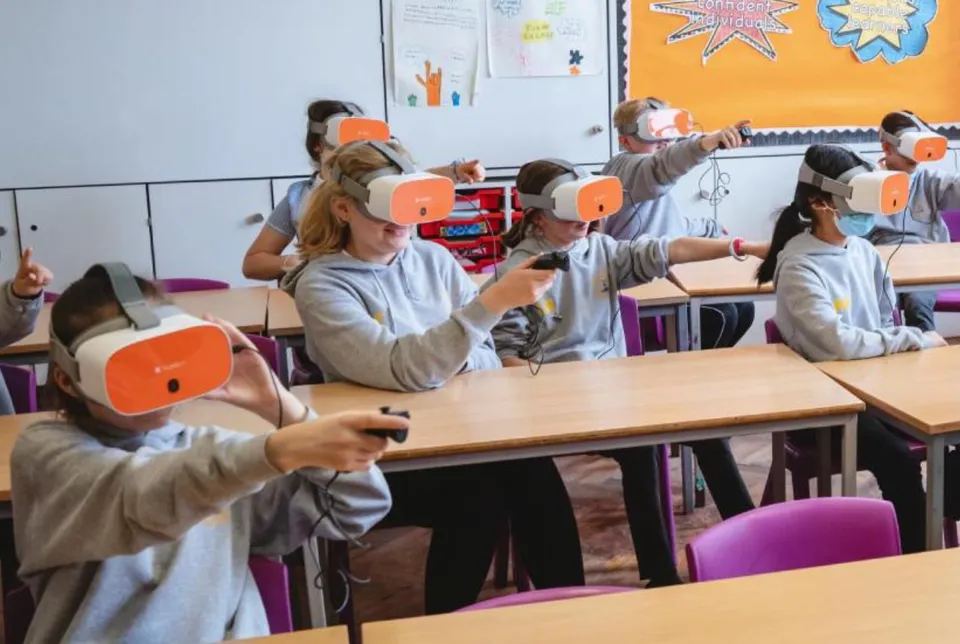
Education and professional training are among the areas where advanced AR could have a meaningful impact.
A training application can place instructions directly within a learner’s environment, reducing the need to constantly look between a physical task and a separate screen.
For example, medical training could use AR overlays to guide learners through simulated procedures. Technical education could display step-by-step instructions while students work with equipment.
AR can also support classroom simulations by allowing teachers to create interactive scenarios that would be difficult to reproduce physically.
Stable object placement and accurate occlusion are especially important in these situations. If instructions appear in the wrong location or digital objects fail to align with the physical environment, the learning experience can become confusing.
Research in medical education has explored the use of AR for clinical skills and training. A 2024 randomized crossover trial involving 47 trainees reported benefits from AR overlays during ultrasound-guided central venous catheter placement, including faster performance of critical steps and reductions in some measures of cognitive load.
A separate 2024 scoping review examined 37 studies and reported that AR can support clinical skills development. These findings do not mean AR is appropriate for every lesson, but they demonstrate why better scene understanding and stable digital overlays can be valuable in hands-on education.
ARK Augmented Reality for Gaming and Entertainment
Entertainment is another area where AR needs to be fast, responsive, and reliable.
A game can quickly lose its appeal if characters shake, objects move incorrectly, or the environment takes too long to scan. Players expect digital content to respond naturally to their surroundings.
ARK-style scene understanding could help create more interactive experiences by allowing virtual characters and objects to respond to physical environments.
Different platforms can support different experiences.
Smartphones
Mobile AR is accessible to a large audience and works well for social experiences, product demonstrations, lightweight games, and interactive applications.
Smart Glasses
Devices such as Magic Leap 2 and other wearable platforms can provide hands-free experiences. These devices can be useful for guided activities, location-based entertainment, and persistent spatial content.
Mixed Reality Headsets
High-end headsets such as Apple Vision Pro can provide larger and more immersive spatial experiences. They can support more complex interactions where digital content responds closely to the user’s physical environment.
The wider popularity of AR also demonstrates the demand for interactive experiences. In its February 2026 full-year results, Snap reported that more than 350 million Snapchat users engaged with AR each day on average during Q4 2025, while more than 450,000 developers had created over 5 million Lenses.
For creators, platforms and tools such as Lens Studio, Camera Kit, and Spectacles provide ways to develop and distribute AR experiences across different devices.
The next challenge is making these experiences more intelligent so digital content can respond naturally to the spaces and people around it.
The Future of ARK and Intelligent AR
The future of AR is likely to involve more than simply placing digital objects on a camera screen.
As AI systems become better at understanding images, language, and environments, AR experiences could become increasingly responsive.
Imagine entering a new room and having an AR application understand the basic layout without extensive manual setup. The system could identify surfaces, recognize relevant objects, and decide where digital information would be most useful.
In education, the same technology could adapt lessons to different environments. In gaming, virtual characters could interact more naturally with real spaces. In training, instructions could adjust based on the user’s position and surroundings.
These possibilities are still developing, and practical limitations remain. Developers must continue testing performance, accuracy, privacy, and usability before deploying these systems at scale.
Final Thoughts
ARK augmented reality represents an approach to making augmented reality more intelligent and adaptable.
By combining scene understanding, knowledge, memory, AI-based generation, and AR technologies such as depth sensing, motion capture, scene geometry, and people occlusion, developers can move toward experiences that feel more connected to the physical world.
The potential applications are broad. Education and training can benefit from context-aware guidance. Gaming and entertainment can become more immersive. Wearable devices can deliver more useful hands-free experiences, while mixed reality applications can respond more naturally to changing environments.
The most practical way to explore ARK-style technology is to begin with a focused project. Test one device, one environment, and one specific task. Once placement, tracking, occlusion, and interaction work reliably, the experience can gradually be expanded.
The future of augmented reality will depend not only on how impressive virtual content looks, but also on how well it understands the real world around it. That is where approaches like ARK could make a meaningful difference.
FAQs
What is ARK augmented reality?
ARK augmented reality refers to an approach that combines augmented reality with AI-based scene understanding, knowledge, and memory. The goal is to help digital content respond more intelligently to physical environments.
How does ARK work?
ARK-style systems use visual information, contextual knowledge, and AI techniques to better understand scenes. Combined with AR technologies that track movement and environmental geometry, this can help create more realistic and interactive digital experiences.
What are the main advantages of ARK?
Potential advantages include better scene understanding, improved object placement, stronger immersion, greater adaptability to unfamiliar environments, and more interactive experiences across education, training, gaming, and mixed reality.
Where can ARK augmented reality be used?
Potential applications include education, medical training, technical instruction, gaming, entertainment, retail, smart glasses, and mixed reality. The technology is especially useful when digital content needs to interact with physical surroundings.
Does ARK work with ARKit?
ARK research and ARKit are not the same technology. ARK refers to research and an approach involving knowledge, memory, and scene understanding, while ARKit is Apple’s framework for building augmented reality applications. ARKit features such as depth sensing, scene geometry, people occlusion, and motion capture can support AR experiences that use similar scene-aware concepts.