
At the battle of Fontenoy, on 11 May 1745, the commander of the Highland Regiment went to the Duke of Cumberland with an unusual request. He wanted permission for his men to fight in their own way.
Sir Robert Munro of Foulis was sixty years old, a baronet, a former Member of Parliament, chief of his clan, and by his own cheerful admission extremely fat. His regiment was the one the Gaels called the Black Watch. It had never been in a battle before. Sir Robert knew that his Highlanders had not been raised on the parade-ground drill of the regular army, standing upright in ranks to trade volleys at forty paces. They had been raised on something older. At Fontenoy his men wore the dark government plaid; the red Munro tartan that his clan wears now is a later story, and a stranger one.
Cumberland agreed. And so, when the regiment advanced against the French positions that day, the astonished allied army saw the Highlanders do something no other troops on the field did. Each time the French line levelled its muskets, the whole regiment dropped flat on the ground. The volley passed over them. Then they sprang up, closed the distance at a run, fired, and went in with the broadsword.
There was one exception. The colonel could get down, but he was not at all sure he could get up again. So each time his men threw themselves on their faces, Sir Robert Munro stayed on his feet, alone, with the colours behind him, and let the French shoot at him. They missed every time.
Castle Foulis ablaze
The Munros come from the north shore of the Cromarty Firth, in Easter Ross, a strip of good farmland under the great hump of Ben Wyvis. The Gaels called it Ferindonald, Donald’s land, after the clan’s traditional founder. The chiefs have lived at Foulis for some seven hundred years. Their war cry was Caisteal Folais na theine, Castle Foulis ablaze, from the beacon that was lit on the tower to call the clan in. Their crest is an eagle, and their motto is the bluntest in the Highlands: Dread God.
They were soldiers by trade. In the seventeenth century so many Munros served in the Swedish army of Gustavus Adolphus that at one time, it was said, there were three generals, eight colonels and more than thirty captains of the name in it. They came home Presbyterian and stayed that way. When the Stuarts were driven out in 1688, the Munros stood by the new government, and they stood by it again in 1715 and 1719.
So when General Wade raised six Independent Companies in 1725 to police the Highlands, it was natural that one of them should be a Munro company. When those companies were formed into a regiment in 1739, Sir Robert was its lieutenant-colonel, and in practice its commander. He was the man who turned a Highland police force into a regiment of the line.
Falkirk
Fontenoy was a defeat, but the Highlanders covered the retreat and came out of it famous. Sir Robert was promoted to the command of an English regiment, the 37th Foot. Then, that same summer, Prince Charles Edward Stuart landed in the west, and the army was called home.
On 17 January 1746, in a winter storm on Falkirk Muir, the government army met the Jacobites and broke. The 37th ran with the rest. Their colonel did not, possibly because running was no more in his line than lying down. By the account published soon afterwards, Sir Robert was surrounded by six men of Cameron of Lochiel’s regiment. He killed two with his half-pike. A seventh came up and shot him, and he was finished on the ground with a sword cut to the head.
His younger brother, Dr Duncan Munro, a physician who had come along to look after him, ran up unarmed to help and was killed beside him. The Jacobites found the bodies the next day. They buried the two brothers with military honours in Falkirk churchyard, and several of the Jacobite chiefs are said to have attended.
The Lochiel puzzle
Now comes the odd part, which no novelist would dare invent.
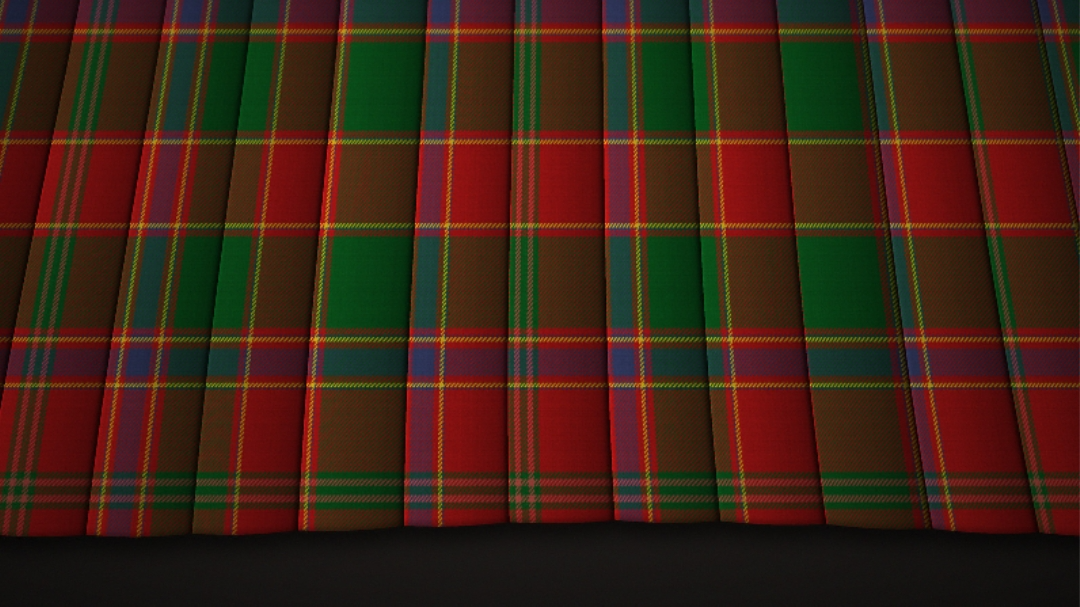
bands, a central stripe of dark blue edged with thin yellow lines, and a distinctive group of three narrow green lines set on the red. It has been worn as Munro for at least a hundred and seventy years. In 1850 the Smith brothers of Mauchline, publishing their collection of authenticated tartans, wrote that they were giving “the pattern which has been longest known by the Manufacturers as ‘The Monro Tartan’.”
But researchers going through the older records of the great Bannockburn weavers, William Wilson & Sons, found the same pattern being woven around 1800 under a different name. They had called it Lochiel.
Lochiel is the title of the chief of Clan Cameron. It was men of Lochiel’s regiment who killed Sir Robert Munro at Falkirk.
Nobody knows how a cloth once sold under the name of the Camerons’ chief became the tartan of the clan whose chief they cut down. The notes in the Scottish tartan registers simply say that how it became a Munro tartan “is a mystery,” and add that the sett is nonetheless “usually regarded as the correct form.” The likeliest explanation is the dullest. Around 1800, tartans were trade goods. Weavers named patterns to please customers and renamed them when it suited, and the associations that lasted were the ones people chose to wear. The Munros chose this one. Two centuries of their chiefs have worn it, and that is what makes it theirs. A Munro looking for a kilt for men today will usually be shown the red sett first.
For clansmen who find the red too bright there is a second tradition, and it leads straight back to Sir Robert. Because of the clan’s part in founding the Black Watch, Munros have long worn the dark Government sett as their hunting tartan. Suppliers of Munro tartan generally offer the red sett in Modern, Ancient and Weathered colours, made to order as kilts, skirts, waistcoats and scarves or sold by the yard.
The other Munro
There is one more member of the family to meet before we come to the present, because his name is spoken in Scotland every weekend of the year.
Sir Hugh Munro of Lindertis, a cadet of the house of Foulis, was a founder member of the Scottish Mountaineering Club. In 1891 he published a list of every Scottish mountain over three thousand feet. People had assumed there were perhaps thirty. He counted nearly three hundred. The hills on his list have been called Munros ever since, there are 282 of them on the current reckoning, and climbing the lot has become a national pastime with thousands of finishers.
Sir Hugh never finished. He died in 1919 with a handful of his own summits still unclimbed, which has been a comfort to everyone who has ever turned back in bad weather.
Number 282
On a Saturday in late June a party of eleven people is walking slowly up the last few hundred feet of a mountain in the north-west Highlands. They are carrying, between them, two bottles of champagne, a box of plastic glasses and a small cake. At the front is a man of fifty-three, in boots, gaiters and a kilt.
His name, as it happens, is Munro, though he is from Calgary and had never set foot in Scotland until he was thirty. He came over for a conference, climbed Ben Lomond on a free afternoon, and was lost. He has spent most of his holidays since working through the list. Today is the last one. It is traditional to finish in style, and he decided a year ago that he would do it in his own tartan.
Buying the kilt was its own small expedition. He learned that what a specialist sells as a kilt for men ranges from nine yards of formal pleated tartan through lighter casual versions to hybrids, denim and cotton utility kilts. For a mountain he did not want eight yards of cloth. He wanted the five-yard version: the same garment with shallower pleats, a good deal lighter, cooler on the climb, and quicker to dry. He wanted it in a washable yarn, since it was going up a hill and not down an aisle.
He measured himself the way the instructions said. Waist at the navel, which is higher and wider than where his trousers sit. Hips at the fullest point. Length from the waist to the middle of the kneecap, found by kneeling on the floor and measuring to the ground. Three numbers, and the kilt was cut to them. He ordered it in the Ancient colouring, where the red softens towards orange and the green towards moss, because it seemed to him the right thing to wear on a hillside.
It has been a surprisingly good piece of mountain clothing. It is cool on the ascent and warm enough at the top. It does not bind at the knee on steep ground. He has woollen hose pulled up under his gaiters and a waterproof in his pack, because he has been in these hills often enough not to trust a June forecast.
The cairn comes into view. His friends fall back to let him touch it first. Somebody opens the champagne. Somebody else, who has been reading up, raises a plastic glass to a fat colonel who would not lie down, and a baronet who never finished his own list.
The man in the red kilt looks out over a hundred miles of country he did not grow up in and says the only thing that comes to mind, which is the family motto.
“Dread God,” he says. “And check the forecast.”
What they wore
Sir Robert Munro fought at Fontenoy in the dark plaid of the regiment he made, and died at Falkirk in an English red coat. The scarlet tartan that carries his name was woven after his time, under the title of his enemies, and came to his clan by a road nobody can now trace. None of that seems to matter to the people who wear it. A tartan does not have to be ancient, or even explicable. It has to be worn, on the great days and on the hill, by people who know the story that goes with it, and the Munros have a good one.