
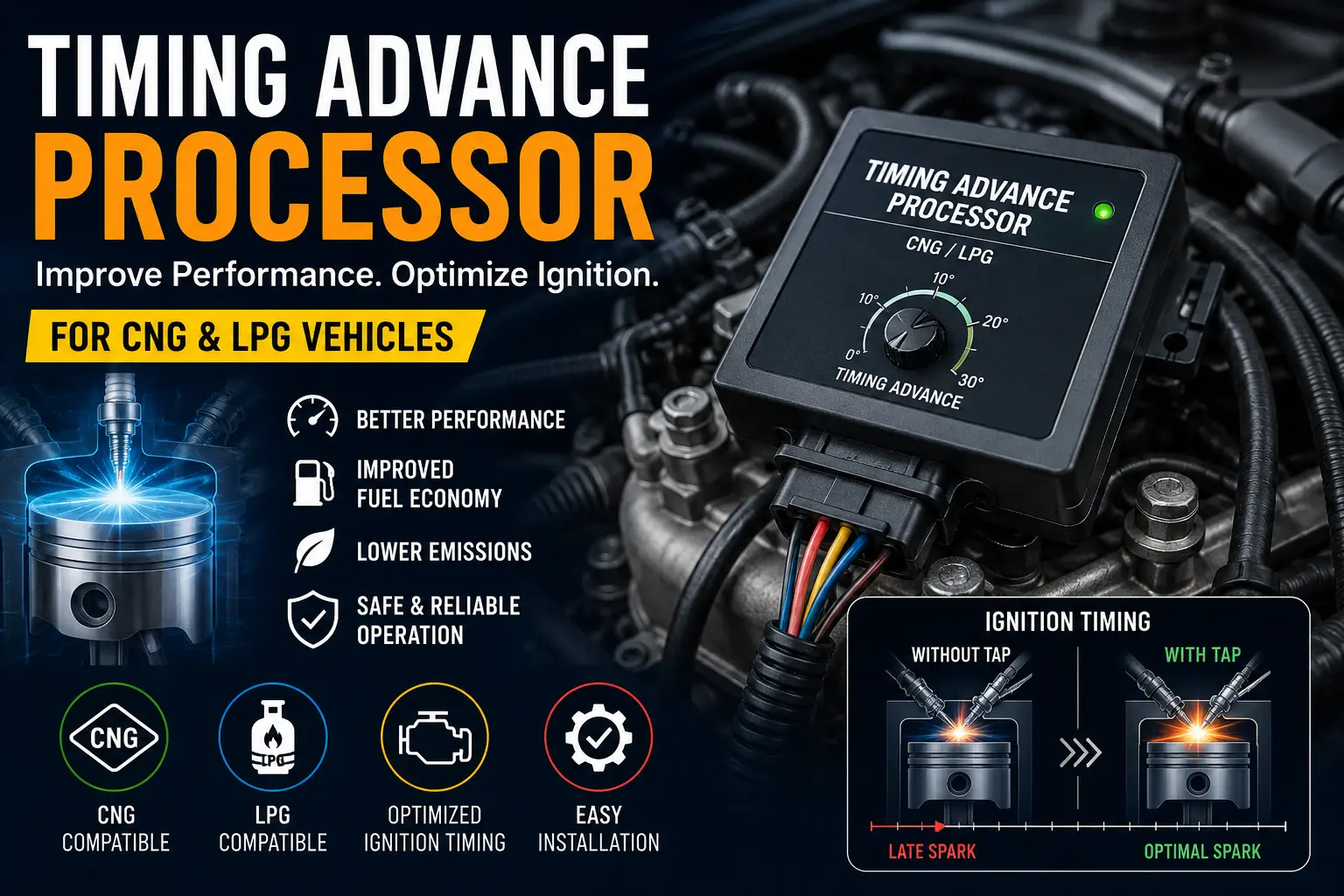
When an engine is converted to run on CNG or LPG, the combustion process changes. The fuel may burn at a different rate than gasoline, which can affect ignition timing, throttle response, fuel economy, and overall drivability. A timing advance processor helps manage this difference by modifying the ignition signal so the spark occurs at a more suitable point for the alternative fuel being used.
This small electronic device can play an important role in dual-fuel and gas-powered vehicles. However, choosing one is not simply a matter of buying a processor and connecting it to the wiring. The correct unit depends on the vehicle’s ignition architecture, sensor type, fuel system, and the amount of timing adjustment required.
This guide explains the technology in practical terms. You will learn what these processors do, how they interact with different ignition systems, what advantages they can provide, how compatibility is determined, and what to check before installation or calibration.
What Is a Timing Advance Processor?
A timing advance processor is an electronic device designed to alter the ignition timing signal supplied to an engine. Its main application is often found in vehicles using gaseous fuels such as compressed natural gas (CNG) or liquefied petroleum gas (LPG).
The ignition system normally determines when the spark plug should ignite the air-fuel mixture. That timing is calibrated around the combustion characteristics of the fuel for which the engine was originally designed. When another fuel is introduced, the ideal spark point may change.
The processor modifies the relevant ignition signal to compensate for this difference.
The basic idea is straightforward:
- The engine generates an ignition or position signal.
- The processor receives and interprets that signal.
- The device modifies the timing according to its programmed or adjustable settings.
- The ignition system receives the modified signal.
- The spark occurs at a different point in the engine cycle.
The exact method depends on the vehicle’s ignition architecture. Older engines may use distributor-based systems, while modern vehicles commonly rely on crankshaft position sensors and sophisticated engine control units.
A properly selected unit can help an engine operate more smoothly on gas fuel. An incorrectly selected or poorly calibrated unit can produce the opposite result.
Why Ignition Timing Changes With CNG and LPG
Fuel does not behave identically inside an engine. Different fuels have different characteristics related to flame propagation, octane rating, mixture preparation, and combustion behavior.
Gasoline engines are calibrated around gasoline’s combustion characteristics. When the engine switches to CNG or LPG, the combustion event may require a different ignition strategy.
For example, CNG has a high octane rating and can tolerate relatively advanced ignition timing under suitable operating conditions. Its combustion characteristics may also require the spark to occur earlier to achieve efficient pressure development inside the cylinder.
LPG has its own combustion and vaporization properties. The exact timing requirement depends on the engine design, fuel mixture, compression ratio, operating load, and conversion system.
This is why simply changing the fuel does not always deliver the best results.
Without appropriate timing control, a converted engine may experience:
- Sluggish acceleration
- Reduced throttle response
- Poor fuel economy
- Rough running
- Difficult starting
- Loss of power
- Combustion knock under certain conditions
- Increased exhaust emissions
The correct timing strategy varies from one engine to another. A processor is therefore best viewed as a calibration tool rather than a universal performance upgrade.
How the System Adjusts Ignition Timing
Ignition timing is measured in relation to the position of the piston, usually referenced to top dead center (TDC). The spark is often initiated before the piston reaches TDC so combustion pressure develops at an appropriate point during the power stroke.
The amount of advance can vary according to:
- Engine speed
- Engine load
- Fuel type
- Engine temperature
- Compression ratio
- Combustion chamber design
- Existing ignition strategy
- Manufacturer calibration
A basic processor may provide a fixed or adjustable timing offset. More advanced systems can use different strategies depending on engine operating conditions.
For instance, an engine may need a different timing adjustment at idle compared with higher RPM. A setting that works well during cruising may not be appropriate under heavy acceleration.
This makes calibration particularly important.
A simple example
Imagine an engine originally calibrated for gasoline. After conversion to CNG, the vehicle feels weaker when accelerating and does not respond as quickly as it did on gasoline.
If the ignition timing is not suitable for the new fuel, the combustion event may not occur at the most effective point. An appropriate timing adjustment can help restore more efficient combustion.
However, advancing the timing too far can create its own problems. Excessive advance may contribute to abnormal combustion, drivability issues, or mechanical stress.
The goal is not to achieve the maximum possible advance. The goal is to achieve the correct advance for the engine and fuel combination.
Understanding Compatibility With Different Ignition Systems
One of the most important parts of selecting a processor is identifying how the vehicle generates and controls ignition timing.
A device designed for an older distributor-based ignition system may be completely unsuitable for a modern crankshaft sensor system. Signal characteristics, wiring, voltage levels, and control methods can differ significantly.
Older breaker-point ignition
Classic engines may use mechanical breaker points inside a distributor. These systems are relatively simple compared with modern electronic ignition systems.
A processor intended for this architecture must interact with the ignition signal correctly without interfering with the basic operation of the coil and distributor.
Because these systems are less common in modern vehicles, specialized units are generally required.
Electronic distributor ignition
Many vehicles moved from mechanical breaker points to electronic switching while retaining a distributor.
These systems still rely on distributor-based ignition distribution, but electronic components control the switching process.
The processor must be compatible with the signal produced by the ignition module. Incorrect wiring or an incompatible device can prevent the engine from starting or cause unstable operation.
Ignition systems controlled by electronic modules
Some engines use dedicated ignition modules to manage spark generation. These systems may already perform significant timing calculations.
Adding another timing control device requires careful consideration because the processor is interacting with an existing electronic control strategy.
Programmable units can be useful in applications where the timing curve needs to be customized. However, this requires accurate knowledge of the engine’s operating requirements.
Crankshaft position sensor systems
Modern engines frequently use a crankshaft position sensor (CKP) to determine crankshaft speed and position.
The sensor may use different technologies, including:
- Inductive or variable-reluctance sensing
- Hall-effect sensing
- Other digital position-sensing arrangements
The signal generated by these sensors is critical to engine operation. A processor working with a CKP signal must preserve signal quality and correctly interpret the sensor’s characteristics.
This is one reason modern installations are generally better handled by technicians with experience in electronic engine management systems.
What to Check Before Buying a Processor
The right device should be selected only after identifying the vehicle’s exact ignition configuration.
Here are the most important factors to evaluate.
1. Identify the ignition architecture
Determine whether the engine uses:
- Breaker points
- Electronic distributor ignition
- A separate ignition module
- A crankshaft position sensor
- A more advanced engine control unit
Never assume compatibility based only on the vehicle’s make and model.
2. Confirm the sensor technology
If the vehicle uses a CKP sensor, determine whether it is inductive or Hall effect.
The processor must be capable of handling the specific signal type. A mismatch can lead to unreliable timing information or complete ignition failure.
3. Check the fuel application
Confirm whether the processor is designed for:
- CNG
- LPG
- Both CNG and LPG
The fuel system and engine calibration should be considered together.
4. Determine the required timing range
Different engines require different amounts of timing adjustment. Some applications may work with a simple fixed adjustment, while others benefit from a programmable curve.
Avoid selecting a device based solely on the largest available timing range. More adjustment does not automatically mean better performance.
5. Consider the installation method
Look at how the unit connects to the existing system.
A processor may require connections to:
- Ignition coil circuits
- Distributor signals
- Ignition module outputs
- Crankshaft sensor wiring
- Power and ground
- Fuel selection signals
The wiring diagram should always match the actual vehicle configuration.
6. Look for a bypass function
A bypass or emergency connector can be useful during troubleshooting. It allows the original ignition signal path to be restored if the processor develops a fault.
This feature can simplify diagnostics and reduce the risk of being stranded because of a processor malfunction.
Advantages of Using Ignition Timing Control
A correctly matched and calibrated system can offer several practical benefits.
Better drivability
One of the most noticeable improvements may be smoother operation when the vehicle switches from gasoline to gas.
The engine can respond more naturally to throttle input when the ignition timing is suitable for the selected fuel.
Improved fuel utilization
Efficient combustion can help the engine extract more useful energy from the fuel consumed. The actual improvement depends on the vehicle, conversion quality, driving conditions, and calibration.
A processor should not be considered a guaranteed fuel-saving device. Its value comes from optimizing ignition timing as part of a properly configured fuel system.
More consistent performance
A well-calibrated ignition strategy can reduce the performance gap between gasoline and alternative-fuel operation.
This can be particularly useful for vehicles that frequently switch between two fuels.
Potential emissions benefits
Better combustion can contribute to cleaner engine operation. However, emissions depend on the entire fuel conversion system, including mixture control, oxygen feedback, catalytic converter condition, and engine maintenance.
Ignition timing is only one part of the equation.
Timing Advance Processor vs Standard Ignition Timing
| Feature | Standard ignition setup | With dedicated timing control |
|---|---|---|
| Original fuel calibration | Optimized for factory fuel | Can be adapted for alternative fuel |
| Timing flexibility | Usually limited by factory strategy | May allow additional adjustment |
| CNG operation | May require compromise | Can be optimized when compatible |
| LPG operation | Depends on factory calibration | Can be adjusted for conversion setup |
| Calibration potential | Often factory controlled | Fixed or programmable depending on model |
| Installation complexity | Factory installed | Requires correct wiring and setup |
| Diagnostic requirements | Standard vehicle diagnostics | Additional system checks may be required |
The important point is that additional timing control is not automatically better for every vehicle. Modern engines may already have sophisticated electronic timing management, so any modification must be compatible with the original control system.
Installation and Calibration Basics
Installation should follow the processor manufacturer’s wiring diagram and the vehicle’s ignition configuration.
A general process may involve:
- Disconnecting the battery where appropriate.
- Identifying the correct ignition signal.
- Confirming the wiring diagram.
- Mounting the device away from excessive heat and moisture.
- Connecting power and ground correctly.
- Integrating the processor with the relevant ignition circuit.
- Checking all connections before starting the engine.
- Testing the vehicle at idle and under different operating conditions.
- Adjusting timing gradually.
- Verifying that the original ignition system remains functional.
The exact installation procedure varies considerably between systems.
For a CKP-based application, technicians may need to verify the sensor waveform and signal integrity. In some cases, specialized diagnostic equipment can help confirm that the processor is receiving and transmitting the correct signal.
Calibration should be approached carefully.
A practical starting strategy is to use the manufacturer’s recommended configuration and then evaluate:
- Idle quality
- Starting behavior
- Throttle response
- Acceleration
- Engine load response
- Fuel consumption
- Abnormal combustion symptoms
Any adjustment should be made methodically rather than changing several settings at once.
Common Problems and What They May Indicate
Timing-related problems can have several causes. The processor is not always responsible.
| Symptom | Possible explanation |
|---|---|
| Engine feels weak | Timing may be unsuitable or fuel mixture may be incorrect |
| Rough idle | Incorrect calibration, vacuum leak, or ignition issue |
| Poor acceleration | Excessive or insufficient timing adjustment |
| Hard starting | Wiring, sensor, fuel, or ignition problem |
| Engine knock | Timing may be too advanced or another combustion issue may exist |
| Processor appears inactive | Power, ground, signal, or configuration problem |
| Intermittent running | Loose wiring or unstable sensor signal |
A key diagnostic principle is to avoid changing timing settings before confirming that the rest of the system is functioning correctly.
Spark plugs, ignition coils, wiring, fuel injectors, regulators, sensors, and air-fuel mixture all affect engine performance. A timing adjustment cannot compensate for a damaged component.
The Importance of a Bypass or Emergency Connection
A bypass feature provides a practical way to isolate the processor from the ignition system.
If a vehicle suddenly develops a fault after installation, a technician can bypass the additional timing control and check whether the engine returns to its original behavior.
This can help determine whether the processor or another part of the conversion system is responsible.
A bypass may be particularly useful when:
- The engine suddenly stops running correctly
- A wiring fault is suspected
- Diagnostic testing is required
- The processor needs to be removed temporarily
- The vehicle must return to its original ignition configuration
The bypass should be installed and used according to the manufacturer’s instructions. It is not a substitute for repairing the underlying problem.
How to Get Better Results From CNG and LPG Conversions
Ignition timing should be treated as one part of a complete alternative-fuel conversion.
For the best results, pay attention to the entire system.
Maintain the ignition system
A weak ignition coil or worn spark plugs can cause poor combustion regardless of timing adjustments.
Regularly inspect:
- Spark plugs
- Plug wires where applicable
- Ignition coils
- Distributor components on older engines
- Electrical connectors
- Engine grounds
Keep the fuel system correctly calibrated
An engine with an incorrect air-fuel mixture may perform poorly even with perfectly adjusted ignition timing.
CNG and LPG systems should be checked for correct pressure, fuel delivery, and mixture control.
Monitor engine behavior
Pay attention to changes in:
- Fuel consumption
- Engine temperature
- Acceleration
- Idle stability
- Starting performance
- Unusual noises
A change in any of these areas may indicate that the calibration needs attention.
Avoid aggressive settings
More advance is not always better.
The safest calibration is the one that provides the desired combustion performance without causing abnormal combustion or drivability problems.
When Professional Installation Makes Sense
Some basic ignition systems are relatively straightforward, but modern electronic engines can be significantly more complicated.
Professional installation is particularly advisable when:
- The vehicle uses a CKP sensor
- The engine has complex electronic controls
- The processor is programmable
- The fuel conversion system is newly installed
- You are unsure about sensor signal type
- The wiring diagram is unclear
- The engine has existing performance problems
A qualified technician can identify the ignition architecture, verify signal compatibility, and use appropriate diagnostic equipment.
This is often cheaper than replacing damaged components after an incorrect installation.
Practical Checklist Before Installation
Use this checklist before purchasing or fitting a unit:
- Confirm the exact vehicle and engine
- Identify the ignition system
- Determine the sensor type
- Confirm CNG or LPG application
- Check processor compatibility
- Review the wiring diagram
- Verify the required timing adjustment range
- Confirm power and ground requirements
- Check for a bypass function
- Inspect the existing ignition system
- Verify the fuel conversion system is correctly calibrated
- Plan how timing changes will be tested
- Keep the original settings documented
This simple preparation can prevent many installation problems.
Frequently Asked Questions
What does a timing advance processor actually do?
A timing advance processor modifies the ignition timing signal so the spark can occur at a more suitable point for the fuel being used. It is commonly applied to CNG and LPG conversions where the combustion characteristics differ from gasoline. The exact operation depends on the ignition architecture and the processor design.
Can a timing advance processor increase engine power?
It can improve drivability and help recover performance that may otherwise be lost after converting to an alternative fuel. However, it does not automatically create additional engine power. Results depend on the engine, fuel system, ignition condition, calibration, and timing strategy.
Is every processor compatible with every vehicle?
No. Compatibility is one of the most important considerations. Different engines use different ignition signals and sensor technologies. A device designed for a distributor-based system may not work with a modern CKP sensor setup. Always verify the exact application before installation.
Does CNG always need more ignition advance?
Not necessarily in every operating condition. CNG has combustion characteristics that can make additional advance beneficial in many applications, but the correct setting depends on engine design, load, RPM, compression, mixture, and the conversion system. The ideal calibration should be determined for the specific vehicle.
Can incorrect timing damage an engine?
Incorrect ignition timing can contribute to poor combustion, overheating, abnormal combustion, or reduced performance. The risk depends on the engine and the severity of the calibration error. Excessive advance can be particularly problematic under certain operating conditions, which is why adjustments should be made carefully.
Should the processor be recalibrated over time?
It may not require routine adjustment if the system remains stable and properly configured. However, recalibration or inspection can be useful after major engine repairs, fuel-system changes, sensor replacement, or when performance changes occur. Periodic diagnostic checks can help identify developing problems.
What should I do if the vehicle runs badly after installation?
First, check the wiring, power supply, grounding, sensor connections, and fuel system. If the processor has a bypass function, following the manufacturer’s procedure to return temporarily to the original ignition signal can help with diagnosis. If the problem disappears after bypassing the device, further inspection of the processor or its calibration may be necessary.
Is professional installation necessary?
It depends on the vehicle and system complexity. Older distributor-based applications may be simpler, while modern sensor-driven ignition systems can require specialized knowledge and diagnostic tools. Professional installation is a sensible choice when the processor interacts directly with crankshaft sensors or sophisticated electronic engine controls.
Final Thoughts
A timing advance processor can be a valuable component in a properly designed CNG or LPG conversion, particularly when the engine’s original ignition strategy does not fully suit the alternative fuel. Its effectiveness depends on selecting the correct device, matching it to the ignition architecture, installing it accurately, and calibrating it conservatively.
Timing advance processor best approach is to treat ignition timing as part of the complete engine management system rather than as an isolated modification. Start by identifying the vehicle’s ignition and sensor technology, confirm compatibility, check the condition of the existing ignition components, and use reliable diagnostic methods during calibration.
When the hardware and settings are correctly matched, alternative-fuel vehicles can achieve smoother operation, better drivability, and more efficient combustion without compromising the original ignition system.